Tag: dover township

  • The Village of Toms River and the Township of Dover in the 18th Century 

    The Village of Toms River and the Township of Dover in the 18th Century 

    By F. Lawrence Fleming 

    Allow me to tell you about Grandpa, who lived in an old house on a farm in the Cedar Grove neighborhood of Toms River, New Jersey. Grandpa and Grandma were not really my grandparents; they were just this elderly couple, friends of my parents, with whom I stayed from time to time while I was attending elementary school. I confess that I didn’t actually know what their surname was when I was a kid. Grandpa and Grandma was what they had told me to call them. (My parents must have mentioned the surname from time to time, but it seems like it went in one ear and out the other.) I’m telling you about Grandpa now because it was he who first got me interested in family history; he got me interested in my own family history, but also in other families’ family history.

    That house in Cedar Grove, known locally as the Dave Marion House, was a very old house. Grandpa told me that it dated back to before the American Revolution, and by the look and feel of things inside and outside of that house, I had little reason to doubt him. The house had its own extensive library of old books, for example. Grandpa had me carefully go through all of these books, one by one, in order that I might find the oldest book in the library. I eventually found it; I remember that it was a book about the cultivation of flax that had been published in 1720—I remember because I’d had to ask Grandpa if he knew what flax was. I also found two books that were hollowed out. They looked like ordinary old books until you opened them up. Grandpa said that inside those two books was where jewels and gold coins had been hidden in Revolutionary times.

    The original owner of the house had been a certain David Marion, who, Grandpa said, was a diehard Loyalist during the Revolution. All those old books in the sitting room had been his. David’s younger brother Francis, on the other hand, was a devoted Patriot; as a matter of fact, he was a very famous Patriot, the one who had earned himself the nickname “Swamp Fox.” Grandpa didn’t know much about the adventures of David Marion, but he knew all the more about the adventures of Francis Marion, the Swamp Fox, who I found to be a wonderful, swashbuckling character—the inventor of guerilla warfare, a great hero of the American Revolution, and a very worthy role model for an eight-year-old boy, although one that was very hard to live up to in the 1950s. I could hardly get my fill of stories about him. Grandpa had two old books about the Swamp Fox, so he knew all the stories. How fortunate I was to be staying in Francis Marion’s old family home in Toms River.

    While staying at the Dave Marion House, I acquired another direct link to the days of yore in Toms River. The old Applegate cemetery was about a half-hour’s walk from the house. Grandpa took me there the first time, but afterwards I would go there on my own, meandering amongst the gravestones, trying to discern the weather-worn epitaphs and the dates of birth and death.

    Grandpa explained to me that the Applegate family had acquired the Marion estate after the Revolution. It would seem that David Marion, extremely disappointed in the outcome of the war, had settled his affairs in New Jersey, had sold his house and farm, and had moved back to dear old England. One of the first things that Jacob Applegate did upon acquiring the Marion estate was to set aside a couple of acres of his land for a cemetery where the family could bury its dead. (Old Mr. Applegate was the first person to be buried in his own cemetery. He was born in 1723, and he had fought against the British during the Revolutionary War. Grandpa showed me Jacob Applegate’s grave.) Grandpa said that the Applegates had intermarried with the other founding families of Toms River, and so a stroll through the Applegate cemetery was like taking a walk in the village of Toms River in the years before the Revolutionary War. And so I swallowed this bait that Grandpa had proffered with hook, line, and sinker. On subsequent visits to the graveyard, I tried to memorize the family names other than Applegate that were chiseled into the tombstones. I still remember some of them to this day. Cook, Irons, Johnson, Wilbur, Wainwright, and Potter seem to have been the most memorable names. Let me tell you; I was inescapably hooked on history. I told Grandpa that I was thinking of writing a book about the Revolutionary War. “One day,” he said. “Maybe one day. Don’t be in a hurry.”

    A couple of years ago, I was considering a trip to Toms River, and so I began to search the Internet looking for any information I could find concerning the Dave Marion House in Cedar Grove. I found nothing at all on the Internet. According to the Maps app at google.com, there is no such house in Cedar Grove. I called my sister and asked her about the house. She said that she believed the house had been demolished when the former Marion property was subdivided into dozens upon dozens of residential building lots. That wonderful house with all its antique inventory; and the fierce sandstone lions that guarded the entrance to the estate; the immaculately maintained front lawn with its sculpted cedar trees and its marble fountain that never spouted any water; the garden, and the apple orchard where my dog was buried—all of this had been erased from the face of the earth. I was appalled. How was it possible that such an undeniably historic house could be demolished, almost at the snap of the fingers, and with no notice of the event being taken in the local newspaper and no protests being registered with the relevant authorities of the township. I felt that someone should be made to pay for this dastardly deed, and so I began to prepare my case for the prosecution by brushing up on my knowledge of the American Revolution. I learned, however, that General Francis Marion, the Swamp Fox, did not have a brother named David. His older brothers were Benjamin, Isaac, Job, and Gabriel. These five boys were all born and raised in South Carolina. and none of them had ever been in New Jersey. Grandpa, that wonderful old rascal, had made up the story about the Loyalist David Marion and his Patriot brother Francis. I still think that it was a good story, but at long last I have realized that it wasn’t a true story.

    There was, however, a historical person named David Marion who had owned the house and farm in Cedar Grove—yes, once upon a time, but not quite that long ago. David Marion Graves was a very successful burlesque performer, songwriter, and impresario from New York City who bought the old Applegate farm as a vacation residence in 1906. Dave Marion died in 1934, and he and his wife Agnes are buried in a cemetery in Toms River—so too are Grandpa and Grandma, by the way. (And no, the old Applegate farmhouse was probably not built as long ago as before the Revolutionary War, but certainly as long ago as before the Civil War. It really was a dastardly deed to tear it down.)

    Upon learning about Dave and Agnes Marion, I realized that Grandpa must have had some personal connection to them. In the census of 1920, Grandpa, 20 years old at that time, is enumerated as having the occupation of farmworker; therefore, I consider it very likely that he had worked the farm for Mr. Marion, possibly having started this work as a teenager. (Grandpa had dropped out of school in the sixth grade.) This is all a rather bold assumption on my part; I have found no definitive proof that this is actually true, and I have tired of looking for the proof, but whatever the case may actually have been, I do know for a fact that Grandpa acquired ownership of the house and farm in 1935 from Clifford Graves, Dave Marion’s eldest son, who was then administrator of the David Marion Graves estate. How did Grandpa ever afford it? Maybe his English father helped him with the financing, or maybe his French-Canadian mother-in-law, who, in the 1950s, was still living in that part of the house that was nearest the apple orchard—an ancient and very mysterious lady, of whose presence in the house I was aware, but whom I never got to meet face-to-face. Of one thing I am sure, however: Grandpa had held the previous owner of the house in very high esteem. He told me that absolutely everything in and about the house was exactly the same in 1956 as it had been on the very day he took over the estate. I realize now that Grandpa, in his younger days, must have been the custodian on Dave Marion’s country estate. Why did he not tell me stories about David Marion Graves, who was just as interesting and inspiring a character as General Marion, the Swamp Fox?

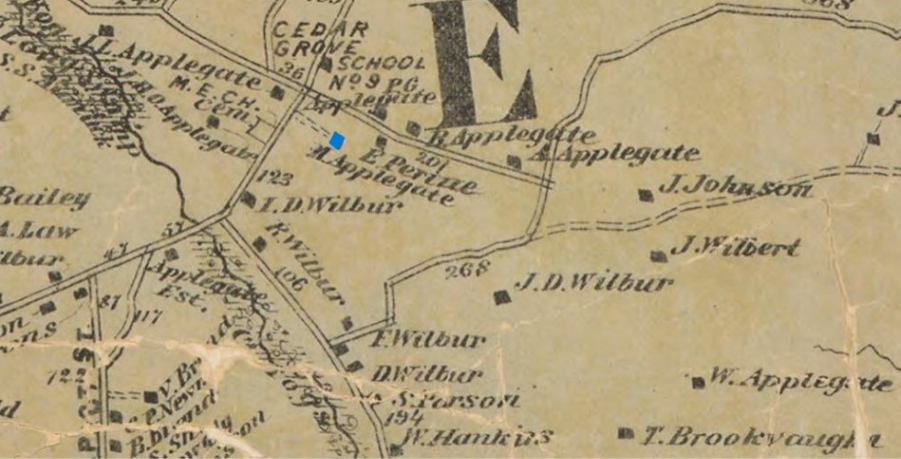
    The Applegate farm in Cedar Grove 1872. The “Marion House” is marked in blue. In 1872, this house belonged to Aaron Applegate (1831-1878) and Sarah Ann Irons Applegate (1833-1917). (It was Sarah Ann who sold the farm to Dave Marion in 1906.) Aaron’s father was John Applegate (b. 1793), who lived to be 100 years old; his grandfather was Jacob Applegate (1767-1851); his great-grandfather was Jacob Jeremiah Applegate (1723-1818), who lived to be almost 100 years old, and who was present in the village of Toms River when it was raided by Loyalists and Pine Robbers in 1782 and was nearly destroyed. All the individuals listed above are buried in the Old Applegate Cemetery in Cedar Grove.

    I have done a considerable amount of research concerning Dave Marion. He was immensely popular as a comedian and a song-and-dance man on the Columbia burlesque circuit, from the late 1880s until the decline of higher-class burlesque performance in the 1920s, when cinema became all the rage instead. David Marion Graves was born in 1864, the son of David and Mary Graves of New York City. I can tell you that David Sr. was very much against his son’s choice of becoming an actor, a choice that David Jr. had apparently made at the tender age of sixteen. David Jr’s father and mother were fishmongers, and we may suppose that they wanted their son to be a fishmonger too. David Sr., however, lived long enough to see his son’s name in lights. Both of Dave Marion’s sons, Clifford and Harold Graves, followed their father into the theatrical profession. (Their stage names were Cliff and Harry Marion.) Dave Marion’s great-grandfather was Issachar Graves (1755-1800), a private in the Continental Army who fought at the Battles of Saratoga in 1777. His 3rd great-grandfather was the mariner Thomas Graves, who arrived in Salem, Massachusetts Bay Colony, aboard the George Bonaventure in 1629, but decided to return to England in 1652 in order to serve the newly-established Commonwealth of England. He was raised to the rank of rear admiral by Oliver Cromwell in 1653, and he was afterwards blown to smithereens at the helm of the HMS St Andrew during a naval battle with the Dutch off the coast of Holland at Scheveningen. I could tell you other stories about Dave Marion and his family, but this is not really the time or the place. Suffice it for me to add that Dave Marion was also very popular in Toms River, his adopted hometown, mostly, it would appear, because of his sincere concern for the effective preservation of local history. Around the time he first acquired the Applegate farm, he proposed the creation of a park in downtown Toms River (present-day Huddy Park) which would commemorate the local militia’s valiant but hopeless defense of Toms River during the infamous Loyalist attack on the 24th of March in 1782. David would appear to have quickly become a passionate local historian, even though he was essentially an outsider in Toms River. How had he known about the Battle of the Blockhouse? He was from New York City, for Pete’s sake.

    David was also a passionate bibliophile. All those old books in the library? They had not been the books of David Marion, brother of the Swamp Fox; they had been the books of David Marion Graves, who was known to his many theatre-loving admirers as Snuffy the Cabman. I have this sneaking suspicion that old Snuffy bequeathed some of his enthusiasm for local history to the young man who actually worked the estate, who actually farmed the farm and gardened the gardens, the man whose wife kept the old house spick and span. It’s true; Grandpa did brazenly tell stories he must have known to be untrue. At other times he made bold assumptions about history that he couldn’t possibly have supported with the help of generally acknowledged historical facts. But I forgive him for these shortcomings. All he really wanted to do, I think, was to color in some of the dazzling blank spaces in history. This is not always possible to do without overstepping the bounds of academic propriety. Believe me; as a protégé of Grandpa, and thereby, perhaps, even of Snuffy—at least, when it comes to matters of history—I am very aware of the ever-present danger of simply going too far in one’s attempts to entertain others with good, well-rounded stories of bygone days.

    Snuffy the Cabman

    The danger of getting carried away is particularly acute as I now prepare to give you an account of some of the people who originally populated the village of Toms River and the township of Dover. There are so many blank spaces that beckon to be filled in, so many graves that lack a proper memorial. What we know, or rather, what we think we know concerning these early citizens of Toms River and Dover Township comes almost entirely from the writings of Edwin Salter (1824-1888). Mr. Salter was a very conscientious amateur historian who always endeavored to support the assumptions he made concerning history with the proper documentation. Nevertheless, practically every local informant he consulted with concerning the history of Toms River had been a grandchild of one of these original citizens.

    “Of course I know what my grandfather did during the war,” one very old informant named Mr. Robbins said in 1870. “He was a private in the Monmouth County militia. He was shot in the face by a Refugee scoundrel back in ‘82.”

    “Can you prove to me that he really took part in the Battle of the Toms River Blockhouse, Mr. Robbins?” Mr. Salter asked with some apprehension. “I mean, do you still have his war pension papers, perhaps?”.

    “I don’t have to prove anything!” the old man retorted, furrowing his brow. “When I was a boy, my grandfather himself told me that he was there, and he had a big scar on his face to prove it. I had no reason to doubt him, nor should you.”

    (Here is perhaps the right opportunity in which to pay tribute to the [professional] historian Michael Adelberg’s project, Celebrating the 250th Anniversary of the American Revolution in Monmouth County, sponsored by the Monmouth County Historical Association at https://www.monmouthhistory.org/. In my opinion, this is historical narration at its best, and although all the primary and secondary sources that support the narrative are painstakingly accounted for, it’s still not boring. How does he do it? As for me, my biggest wish is to succeed in entertaining others. I love history, but I am not a professional historian; I am not a scientist. Therefore, my adherence to academic protocol is not always one hundred percent.)

    A settlement on the Toms River is first mentioned by name in an advertisement that was published in the New Jersey Gazette in 1779: “200 acres of pine land, well timbered, about two miles below Toms River Bridge.” During the years immediately following the Revolution, Toms River Bridge was a village that was referred to in numerous land surveys, for example, in June of 1787: ”42.88 acres. South of the Raritan River; On the North side of Toms River; Toms River Bridge; Dover Township; Monmouth County. Two Tracts: 30 acres; and 12.88 acres.” According to the Dover Town Book 1783-1861, however, a resolution was made at the town meeting of 3 April 1799 that the village of Toms River Bridge would thenceforth be known as the village of Washington.

    In April of 1799, George Washington was alive and, to all appearances, relatively healthy—at least, he seemed healthy right up to his rather sudden death from epiglottitis complicated by excessive bloodletting in December of that year. He had retired from the office of presidency in March of 1797 and was living the quiet life of a wealthy landowner in Virginia. Your guess is as good as mine as to what may have prompted this sudden change of the village name from Toms River Bridge to Washington. It’s true; a placename such as Toms River Bridge does not roll comfortably off the tongue unless it is actually the name of a bridge, but then, neither does the placename of a village unimaginatively called Washington. (I would have suggested a name like “Luker’s Ferry,” in honor of the man who, in effect, founded the village when he built a house on the bank of the south branch of the Toms River in 1747 and started a ferry service across the river, but then, I wasn’t around to do any suggesting in those days.) Fortunately, the resolution of 1799 was never actually enforced. The village continued to be referred to in land surveys as Toms River Bridge as late as in 1830, by which time, however, the village seems to have been referred to colloquially as simply “Toms River,” which I find does roll nicely off the tongue, but probably due to the sheer force of habit.

    Where exactly along the river was the bridge of Toms River Bridge situated, and when was it first constructed? A probable site for this bridge, or rather, these two bridges, can be made evident by means of a satellite map of downtown Toms River. The likely site of these bridges is on South Main Street, at the western end of Huddy Park, between the intersection at Water Street and the intersection at Herflicker Boulevard:

    A quick look at the NJDEP map of historically filled areas in Toms River shows the amount of change to the riverbed that has been caused by infill at the mouth of the Toms River:

    The exact historical location of the two bridges is made more evident on the A. P. Irons 1878 map of Toms River:

    I have marked in blue the two bridges over the river at the village of Toms River. Also evident from this map is the plank road that connected the two abutments on the soft, marshy ground of Shreve’s Island.
    In this map from ca. 1775, “Toms River Bridge” is the name of the bridge over the Toms River.

    The original log bridge that spanned the branch of the river at the northern end of Shreve’s Island (later Gowdy’s Island, nowadays Huddy Park Island), which is called Schenck’s Bridge in 18th-century documents, was constructed in about 1750 at the instigation of Abraham Schenck (1720-1790) of Bushwick, Long Island. Mr. Schenck subsequently had a gristmill built, probably just a short distance downstream from this bridge, a mill which he shortly afterwards sold to Daniel Randolph of Allentown, New Jersey. This simple beam bridge would have had a span of about forty feet. It has, of course, been rebuilt many times since 1750.

    The eponymous Toms River Bridge at the southern end of the island was constructed at some point in time between 1761 and 1775. Almost certainly a single-span beam bridge, this bridge would have had an impressive span of over seventy feet. In about 1840, the Toms River Bridge gave way under the weight of a heavy coal wagon and was replaced with a covered lattice-truss bridge, the only such bridge ever built in Monmouth/Ocean County. In the 1870s, the town’s unique and much-admired wooden bridge was replaced—under considerable protest from the villagers—with an iron girder bridge that was detested as much as the former bridge had been admired. The nondescript present-day concrete bridge was built in 1913.

    In around 1745, a man named Daniel Luker (b. ca. 1700) acquired a large tract of pineland along Wrangle Brook, a tributary of the Toms River, either from Thomas Penn (1702-1775) or Richard Penn (1706-1771), sons of William Penn (1644-1718), the founder of the Province of Pennsylvania. Anyone who has ever been to the Pine Barrens of New Jersey will understand at once that farming and animal husbandry were not at all on Daniel Luker’s mind when he made this acquisition. Arable lands lay to the north and the south of the Toms River estuary. The Toms River itself, however, along with all its tributaries, rises in the vast pinelands to the west of the estuary, which in the 17th and 18th centuries were almost entirely mosquito- and leech-infested cedar swamp—not exactly the best place for homesteading. What Mr. Luker was actually interested in was to exploit the only valuable resource in the pinelands of Monmouth County that people were aware of in those early days, namely, Chamaecyparis thyoides, or the Atlantic white cedar.

    The demand in colonial America for building material cut from white cedar was almost insatiable. The clapboard siding on houses was made from cedar. Roofing shakes were split from short logs of cedar. Beams and rafters were hewn from white cedar. Floorboards were sawn from cedar. And the planking on rowboats, whale boats, sloops, and schooners was fashioned from cedar. Fencing was constructed from slender rails of split cedar. And the best thing about the pinelands in Monmouth County when it came to logging was undoubtedly the circumstance that the best stands of white cedar grew along the watercourses, which facilitated the transport of logs out of the swamps.

    Daniel Luker and other likeminded colonists knew exactly what they were doing. Let others do the farming. The owners of pinelands could buy all they needed for their daily subsistence with the money they earned from logging.

    Daniel would appear to have come to Shrewsbury Township from the city of Philadelphia at some point in time before 1741, the year in which there is record of him purchasing a tract of land from the surveyor James Lawrence. Daniel had married Hester Van at Christ Church in Philadelphia on 24 October 1726. Oddly enough, he does not seem to have originally been from Pennsylvania. (He is the only person bearing the surname “Luker” on record in the state of Pennsylvania prior to the year 1850.) So where was he from? The only other person bearing the Luker surname at the time of Daniels marriage that I am aware of is a certain William Luker of Elizabethtown, New Jersey, who was, with very little doubt, a grandson of Mark Luker (1605-1676) of London, who arrived in the Massachusetts Bay Colony aboard the HMS Griffin in September of 1634. (There is, however, no evidence whatsoever of any familial connection between William Luker of Elizabethtown and Daniel Luker of Philadelphia—apart from the surname.) One source claims that Mark Luker had been the son of a London merchant by the name of Benjamin Luker. I have searched the records of 16th- and 17th-century London without finding reference to any Benjamin Luker; as a matter of fact, I have found reference to only two people in London who bore the Luker surname during the aforementioned period of time. George Luker, according to church records, was buried in Chiswick Cemetery in the London Borough of Hounslow on the 29th of June, 1701. According to this burial record, Mr. Luker had been the son of the surgeon John Luker, who had his practice in the exclusive London neighborhood of Bishopsgate Street. Were these two men members of Mark Luker’s family in London? Was Dr. Luker the father of Mark Luker? Whatever the case may have been, concede the possibility that Daniel Luker had immigrated directly to Philadelphia from London prior to his marriage; that he was possibly related to Mark Luker, although perhaps not a direct descendant; and moreover, that he had first come into contact with the sons of William Penn when he came to Philadelphia around the year 1724.

    (With the risk of seeming somewhat of a bore, I nonetheless feel that I should reiterate here that the fairy story of Thomas Luker, the proposed father of the aforementioned Daniel, who supposedly started a ferry service on the Toms River at the very turn of the 18th century, and then married an Indian princess, and afterwards dressed like an Indian and lived in a wigwam at 40 Main Street, Toms River, New Jersey, is indeed nothing but a fairy story.)

    It was hardly ever Daniel’s intention to work his newly-acquired landholdings by the sweat of his own brow. Indentured servants were just too easy to come by, especially in a port city such as Philadelphia, where the supply of indenture contracts offered up for sale could often exceed the actual demand for laborers. The workers he could recruit in this manner could fell the trees, drive the logs down the river, and then manhandle the logs out of the estuary and onto wagons or, in wintertime, onto sleighs, some logs destined for manual processing by axe and froe at the lumber yard on the north bank of the river, other logs destined for transport to the nearest sawmill to be cut into planks. Daniel himself would be the overseer of all operations and, of course, the collector of all profits made from said operations.

    In a land survey of 1747, reference is made to the dwelling of Daniel Luker on a bank of the Toms River. This dwelling was very likely situated at a natural ford of the river that was anciently known as the “riding over place,” where the stream was, and still is, split into two slender branches by a large island in the middle of the river. (This island is nowadays part of Huddy Park in downtown Toms River.) This was the only place along the Toms River where logs that had been driven downstream could be diverted by means of a log boom to the low banks of the island where they could be hauled out of the water with the help of draft mules and then manhandled onto wagons. Before a bridge was constructed across the branch of the river at the southern end of the island, Daniel Luker ran a ferry, probably to facilitate the transport of logs to the various sawmills in the area. His dwelling at “Luker’s Ferry,” which according to a survey executed by John Lawrence in 1754 was “situate on the first Southerly Branch of Tom’s River in Shrewsbury Township in Monmouth County in the Eastern Division of New Jersey,” was possibly the first of the twenty or thirty houses that would be built between the years 1747 and 1782 at this bend of the river. While Daniel Luker’s house, along with four or five others, would appear to have been built on the southernmost bank of the Toms River, many other houses in the village were undoubtedly situated in a tight cluster on the northernmost bank of the river, that is to say, in the present-day Water Street/Main Street area of downtown Toms River.

    I should like to point out to you at this stage in my blogpost that I cannot prove my history of Toms River, thus far, is altogether true. I have not found any primary sources, or even secondary sources, that unequivocally confirm my theory that the logging and processing of white cedar was the backbone of the economy in those areas that were immediately adjacent to the Pine Barrens. In my defense, however, I should also like to point out that the people in these areas had little else to make a living from. Logging and the processing of logs into building material was about all there was. I think this should be evident from the rather large number of sawmills that were constructed in these areas, beginning as early as in the 1740s. Weirs were constructed across the Toms River and across every one of its tributaries, and also across every tributary of the Toms River estuary, in order to create wheel-races for the operation of sawmills.

    In 1775, Toms River was such a quiet, almost nondescript village that even some of the people in the surrounding townships of Freehold, Shrewsbury, and New Stafford had never heard of it. Toms River first came to the attention of a much wider part of the world following the Loyalist raid on the village in 1782, and the series of events that led to the infamous destruction of the village has a very well-defined initiating event: the establishment of the Pennsylvania Salt Works at Coates Point in 1776.

    In the late spring of 1776, Thomas Savadge (d. 1779), a merchant/entrepreneur from Philadelphia, convinced the Pennsylvania Convention to financially support his proposal for a saltworks, a saltworks to be established on the western shore of Barnegat Bay in New Jersey. Mr. Savadge had told the delegates that he expected to produce more than a million pounds of salt per annum. With grant money in his purse, he travelled to Toms River, where he met with a local landowner and businessman named James Mott, who agreed to sell to him a substantial parcel of salt meadows at Coates Point, the most suitable location in the area for establishing a saltworks. It would appear that Mr. Mott had also agreed to supply the firewood that was necessary for heating the boilers—for a price, of course. Mr. Mott would almost certainly have convinced other residents of Toms River to support this fledgling enterprise in any way they could. Salt was one of those commodities that were in short supply, due to the British Navy’s very effective blockade of all the major colonial ports. There was surely money to be made from this enterprise, and from just a minimal investment.

    In March of 1777, the Naval Board of Pennsylvania sent the armed schooner Delaware to Toms River for the purpose of protecting the Pennsylvania Saltworks from British frigates and Loyalist privateer vessels. The ship remained anchored at Toms River until July when its captain and crew were relieved from guard duty by a detachment of the Pennsylvania Militia.

    By November of 1779, the government of Pennsylvania had finally realized that financing, and then providing protection for, a saltworks in New Jersey that produced no appreciable amount of salt was a lost cause, and so the former Pennsylvania Saltworks was sold to a private citizen of Burlington County for the tidy sum of $15,000. The thankless assignment of protecting the saltworks, and with it the village of Toms River, fell to the local militia, some members of which had built homes in Toms River. Surprisingly, the saltworks at Coates Point, once under private ownership and management, began to actually produce salt. By this time, however, the British Navy’s blockade of colonial port towns was no longer effective, mostly due to the French Navy’s intervention in the war following the 1778 Treaty of Alliance; and therefore, the price of imported salt had fallen drastically.

    In November of 1780, the residents of Toms River petitioned the New Jersey Assembly for a company of State Troops to be stationed in the village in order to protect people and property from attack by Loyalist Refugees and Pine Robbers. A small company of 30 men under the command of Captain David Imlay of Allentown was sent to Toms River in response to this petition. Captain Imlay had a house built for himself and his family in Toms River in 1781, and, we may assume, also a barracks of some sort in which to accommodate the men of his company.

    In December of 1781, the residents of Toms River again petitioned the New Jersey Assembly, this time requesting that a new company of State Troops be raised to relieve Captain Imlay and his thirty odd twelve-months men, whose terms of enlistment were coming to an end. (It is important here to point out that by this time England had already lost the war. It was just a matter of time before the Treaty of Paris would finally be ratified [3 September 1783], officially ending the armed conflict between England and the newly-established United States of America. In my opinion, it would have been a wiser move to leave the responsibility of protecting the village to the local militia, most members of which were permanent residents of Toms River.) The petitioners had requested that Captain Joshua Huddy of Colts Neck be chosen as commander. This was a mistake—once again, in my opinion. Captain Huddy was well-known to Loyalists as a founding member of the Association for Retaliation, a vigilante Whig organization that had in effect been outlawed by the Continental Congress. Choosing Captain Huddy as commander of the troops that were being sent to guard Toms River was like waving a red cape in front of the Board of Associated Loyalists in New York. Some Loyalists believed that it had been Joshua Huddy who himself had fixed the noose around the neck of Loyalist Stephen Edwards when this man was executed as a spy in September of 1777. Moreover, Captain Huddy was known to have done more than his fair share of privateering, and for the British military authorities, Toms River was considered one of the most infamous privateering ports in colonial America, a scourge of London Traders and Loyalists alike. The Board of Associated Loyalists was probably not going to accept this change of guard in Toms River without taking some sort of action to countermand it.

    Captain Huddy and his 25-man company of State Troops arrived in Toms River in February of 1782. They’d only had about a month in which to get settled when a 120-man strong raiding party of Loyalists and Loyalist sympathizers attacked the village. Captain Huddy and some of the men under his command managed to barricade themselves in the blockhouse for a last stand, firing at the Loyalists from inside, but they soon ran out of ball and powder, and so they were forced to surrender. Some of Huddy’s men had been killed before they could climb inside the blockhouse; others were murdered as they climbed out of the fortification following their surrender. The survivors had their hands bound behind their backs and were led away from the continuing mayhem as prisoners of war. The raiders then demolished the blockhouse. The bridge was spared, apparently, but the tavern, the barracks, the gristmill, the wharf-side salt warehouses, and almost all of the family dwellings at the north end of the bridge were burned to the ground.

    The following is an article published in the Loyalist newspaper New York Gazette a few days after the raid on Toms River:

    On Wednesday, the 20th instant, Lieut. Blanchard of the armed whale-boats, and about eighty men belonging to them, with Capt. Thomas and Lieut. Roberts, both of the late Buck’s County volunteers, and between thirty or forty other refugee Loyalists, the whole under the command of Lieutenant Blanchard, proceeded to Sandy Hook, under convey of Captain Steward Ross, in the armed brig Arrogant, where they were detained by unfavorable winds until the 23rd; about twelve o’clock on that night, the party landed near the mouth of Tom’s River, and marched to the block house, at the town of Dover, and reach it just at day light. On the way, they were challenged and fired upon, and when they came to the works, they found the rebels, consisting of twenty-five or six twelve-months men and militia, apprised of their coming, and prepared for defense. The post into which they had thrown themselves was about six or seven feet high, made of large logs, with loop holes in between, and a number of brass swivels on top, which was entirely open, nor was there any way of entering, but climbing over. They had, besides the swivels, muskets with bayonets, and long pikes for their defense. Lieutenant Blanchard called on them to surrender, which they not only refused, but bid the party defiance; on which he immediately ordered the place to be stormed, which was accordingly done, and, though defended with obstinacy, it was soon carried. The rebels had nine men killed in the assault and twelve made prisoners, two of whom are wounded. The rest made their escape in the confusion. Among the killed was a Major of the militia and two captains and one Lieutenant. The Captain of the twelve-months men [Joshua Huddy] is among the prisoners, who are all brought safe to town. On our side, two were killed: Lieut. Iredell of the armed boatmen and Lieut. Inslee of the loyalists, both very brave officers, who distinguished themselves on the attack, and whose loss is much lamented. Lieut. Roberts and five others are wounded, and it is thought some of them in a dangerous way.

    The town, as it is called, consisting of about a dozen houses, in which none but a piratical set of banditti resided, together with a grist and saw mill, were, with the block house, burned to the ground and an iron cannon spiked and thrown into the river. A fine large boat (called Hyler’s boat) and another boat, which the rebels used to make their excursions on our coast, were brought off. The appearance of bad weather and the condition of our wounded, being without either a surgeon or medicines, induced the party to return, where they arrived on the 25th.”

    I should not do justice to the Loyalists who were with me, without expressing the highest prohibition of their behavior and spirit through the whole service; and I beg leave to mention the very great obligation I am under to Captain Ross for his advice, attention to the convoy, and, in a particular manner, for the politeness and tender treatment of the wounded while onboard his brig.

    Capt. Ross has likewise mentioned in his report the Loyalists, during the service, paid every attention, and were willing to assist in every point.”

    Only about a dozen houses? In my estimation, this estimate clearly concerns the number of houses that were clustered at the north end of the bridge, that is to say, the number of houses that were actually destroyed during the raid, and not necessarily the total number of family dwellings in Toms River. Unfortunately, this article is often cited as proof that there were only about twelve to fifteen family dwellings in all of Toms River, and because these were mostly burned to the ground, one can truly speak of the razing of Toms River. The Dover Town Book—1783-1861, however, reveals that the town council’s annual meeting was held, as was apparently the custom, in the village of Toms River in March of 1783, and in the minutes of this meeting nothing is mentioned of the residents not having anywhere to reside, which would have been a topic of some importance if the entire village had been burned down twelve months earlier.

    In January of 1767, a group of residents in the southeastern part of the Township of Shrewsbury had petitioned the Provincial General Assembly that their area should be separated from the existing township. As far as I am aware, the document itself has not survived; therefore, it is mostly a matter of speculation as to what may have prompted the petition in the first place. A response from the General Assembly to this petition came very quickly in the form of a legislative act, ratified on 24 June 1767, an act by which the Township of Dover was established. I think it is important to realize that there was only one settlement of any significance in this newly created township, namely, the village of Toms River Bridge.

    I would like to suggest that the village that had been founded at both ends of the bridge over the Toms River in the 1750s had expanded during the 1760s and 1770s to encompass adjacent areas to the north and to the south; northward along the old road to Freehold, and southward to the shore of the Toms River estuary. Such an expansion would have created the need for a local government run by local citizens, that is to say, Dover Township. I would therefore like to assert that there had to have been quite a few more family dwellings in Toms River than about a single dozen.

    I would also like to suggest that immediately following the Loyalist raid of 24 March 1782, the citizens of Dover Township pooled their economic and social resources and began to rebuild the homes that had been lost. The township certainly had the resources to build a dozen houses within a timeframe of twelve months. This is why the problem of procuring homes for the homeless is never addressed in the minutes of the Dover Township’s town council. By 1783, the village of Toms River had not just survived, it had been rebuilt and renewed; it had actually begun to flourish. As a matter of fact, the citizens of Dover Township never again came into physical jeopardy until the Toms River Chemical Company (later the Ciba-Geigy Corporation) started operations in 1952 at an industrial site on the Toms River and covertly began to discharge toxic processing waste into the river and into the groundwater. This attack was more underhanded and nefarious than the one in 1782, mainly because it specifically, although unwittingly, targeted the children of Toms River.

    So much for the history of Toms River. What I have always wished to figure out is who the people who are buried under the oldest tombstones in Toms River cemeteries actually were—where they were from, what they did, and who their living descendants might be. This is not that easy to figure out, and the results of my endeavor should be taken with a generous pinch of salt. The family histories that I am about to present in this last part of my blogpost are really suggestions meant to inspire further research rather than cut and dried genealogy. All dates of birth and death are only approximate. I shall proceed to list the names that I have found in historical documents relating to the early history of Toms River in alphabetical order, starting with:

    Abiel Akins (1720-1797): He was Justice of the Peace in Toms River. He is also said to have been the owner and manager of a tavern at the south end of the Toms River Bridge. Edwin Salter suggests that Abiel’s wife’s name was Patience, but I think this is a mistake. Patience Howard was married to a blacksmith named James Akin (1728-1817) of Quaker Hill, New York. Abiel does seem to have been married, however, because he appears to have had a son named William, who had succeeded him as a member of the Dover Town Council. William Akins (b. ca. 1750) was married to Lucretia, daughter of Jacob Applegate (1725-1818). Abiel Akins was, by the way, blatantly accused by Samuel Forman, commander of the Monmouth County Militia, of fleeing from the battle at Toms River in 1782. True or not? I don’t think so, I think he just arrived too late to the battle to take part in it, but, of course, we’ll never know for sure.

    Samuel (b. 1757), James (b. 1762), John (b. 1763), and William (b.1767) Allen were all sons of Samuel Allen (1731-1790), a substantial landowner along the Manasquan River. Samuel Jr. was a captain in the Monmouth County Militia during the Revolutionary War, and he is quite famous for exploits that he both was and was not responsible for. James, John, and William appear to have all resided along the Cedar Creek estuary, south of Toms River. These men all served as members of the Dover Township town council in the early 1800s. James Allen was killed in the War of 1812, and is buried in the Wooley/Gravelly Cemetery, in present-day Brick Township, New Jersey. The family history of the Allen brothers of Dover Township goes back to a certain Edward Allen (1633-1696), who came from England and settled in Hartford, Connecticut. Latter-day descendants of the brothers would include John Allen (1779-1871) and his son Captain Isaac Allen, both of whom are buried in Riverside Cemetery in Toms River.

    Jacob Jeremiah Applegate (1723-1818) is buried in Cedar Grove Cemetery in Toms River. His father is believed to have been a certain Bartholomew Applegate of Middletown, New Jersey; his mother, according to Applegate family tradition, was a part-Lenape woman named Mary Esther. His great-great-grandfather was, without any reasonable doubt, Thomas Applegate, one of the original (1645) patentees of Flushing, Long Island, who had emigrated from England, first to the Netherlands, and afterwards (ca. 1634) to the Massachusetts Bay Colony, from which he was soon banished. He resettled in Rhode Island, and finally in New Amsterdam. When this Thomas Applegate’s great-great-grandson Jacob came to Toms River is not known; however, he was married to Esther Irons in 1753, and Esther had been born in Toms River in 1732; thus, it seems reasonable to conclude that Jacob Applegate first came to Toms River sometime before 1750, possibly as early as in about 1740. “Ebeneezer Applegate’s old sawmill,” mentioned in a land survey of 1761, would probably have first been established by Ebeneezer’s father, Jacob Applegate. (Ebeneezer Applegate was born in 1770.) In 1775, Jacob and two of his sons, Bartholomew (b. 1757) and Daniel (b. 1759), were enlisted as privates in Captain John Cook’s company of Monmouth County militia. Bartholomew—and probably Daniel—continued to serve in the militia from 1776 until 1779. It is not known if any of these men took part in the defense of Toms River in 1782. (The historical facts of this matter become muddled due to the circumstance of Jacobs younger brother, Daniel Applegate (b. 1729) of Freehold Township, also having a son named Daniel. According to his Revolutionary War Pension application, it was this Daniel, son of Daniel, who was captured by the Loyalist raiders in 1782. He was apparently serving in the company of State Troops that was commanded by Captain Huddy.) Jacob Applegate of Toms River (Cedar Grove) was elected Constable of Dover Township in 1783, 1788, 1790, and 1791. He had nine sons and at least thirty-five grandsons, which is a good enough excuse for not giving a comprehensive account of his descendants. In Toms River cemeteries, there are graves of more than 500 people named Applegate.

    George Cook (1748-1808): George Cook probably had a house in Toms River, one of those which were burned to the ground by Loyalists in 1782, but one that I believe had been rebuilt by March of 1783. George was a son of Nicholas Cook (1715-1785) of Freehold Township, New Jersey, who was possibly a son of Benjamin Cook (1683-1750) of the Isle of Wight in Virginia. (Cook genealogy in early colonial America is too complicated and contradictory to make head or tails of. Quite obviously, there were several families named Cook that emigrated from England to the American colonies in the 17th century.) George was a lieutenant in the Monmouth County Militia. He was present at the Battle of Germantown and at the Battle of Monmouth. He was in the vicinity of the bridge in Toms River on the 24th of March, 1782, but arrived at the Blockhouse too late to be of any use in its defense. His brother, Major John Cook, was killed while surrendering. George was first married to Margaret —- (b. 1750), who died as a young woman. He then married Parthenia Walker, who would outlive him by five years. He and Parthenia had two sons who both seem to have died at a relatively young age. Fifty-five people named Cook lie buried in Toms River cemeteries, but none of these people would appear to have been descended from the early Cook family of Freehold Township, New Jersey. (This early family has a graveyard of its own in Millstone Township, which is southwest of the town of Freehold.

    John Coward (1728-1777): He is an important man in the history of Toms River. John owned extensive tracts of pineland along the Toms River. He had a sawmill built on the North Branch of the Toms River at some point in time before 1762. He engaged in the logging and lumber business in partnership with James Randolph and Tobias Hendrickson. (Incidentally, James was married to John’s daughter Deliverance, and Tobias was married to John’s daughter Rebecca.) Although John lived in Freehold Township, he would probably have had a dwelling of some sort in the village of Toms River. He was a son of the Rev. John Coward (1704-1760) of Middletown, New Jersey. His grandfather was the mariner Hugh Coward (1680-1725), who was born in Somersetshire, England, but who died in Staten Island, New York, after having undertaken many voyages back and forth across the Atlantic. John was married to Mary Cox (1725-1812). They had two sons, John Coward (1754-1795), who seems to have lived in his father’s house in Toms River, and who was the father of six sons; and Samuel Coward (1759-1777), a private in the Continental Arm at the time of his death. John’s brother was Joseph Coward, who had enlisted in Count Polaski’s Independent Legion, and who was one of the few survivors of the Osborn Island Massacre in October of 1778. The Joseph Coward on whose property the Ocean County Courthouse was built in 1850 was probably a great-grandson of the John Coward who died in 1777.

    James Dillon (b. ca. 1720, d. after 1762) was from Salem County, New Jersey. Nothing is known concerning his ancestry. He was married to Mary Dillon (possibly a second cousin) in the town of Salem in 1739. He purchased land along the Toms River, north of the village, from John Coward in 1762. I think we may safely assume that he built a house on this land, although there is no record of a “Dillon house” north of Toms River. James and Mary had two sons and two daughters. John Dillon (b. ca. 1740, d. after 1787) was the eldest son. While an officer in the Monmouth County Militia, he was captured and imprisoned by the British Army in 1776. Upon his release in 1778, he returned to Toms River and, along with his old militia comrade in arms, Lt. Joshua Studson, he obtained a letter of marque from the Continental Congress, allowing him to operate as a privateer. His younger brother, William, seems to have already been active in privateering at this time, probably without a letter of marque. William was convicted of armed robbery in June of 1778, and he was sentenced to hang. Following his unexpected reprieve by Governor William Livingston, his privateering seems to have turned to outright piracy. He is reputed to have run contraband cargoes along the New Jersey coast from Great Egg Harbor to the ships of London Traders lying at anchor in Lower New York Bay at Sandy Hook. As far as is known, neither John Dillon nor his brother had any sons. On the other hand, the descendants of Mary Dillon Wilbur, daughter of James Dillon, continued to use their old surname as a personal name for several generations. Thus, we have James Dillon Wilbur (1766-1845), Dillon Wilbur (1769-1841), James Dillon Wilbur (1797-1877), John Dillon Wilbur (1803-1882), Dillon Wilbur (1806-1896), Ivins Dillon Wilbert (1816-1897) (A different spelling of the surname, but definitely the same family.), James Dillon Wilbert (1845-1925), Ivins Dillon Wilbert (1853-1942), and John Dillon Wilbert (1879-1946). (Very much o a mystery is the James Dillon who lies buried in Saint Andrew’s Graveyard in Mount Holly, New Jersey. This James Dillon was a captain in the 2nd Regiment, New Jersey Line, of the Continental Army from 1776 to 1780. Taking his date of birth into consideration, and also the fact that he had enlisted in New Jersey, might induce one to surmise that he was a son of James Dillon of Salem, New Jersey. Certainly, there is nothing that links him to either of the other two Dillon families in Colonial America [in North Carolina and Virginia]. I fear his story is a sad one. According to their tombstones in Mount Holly, Captain Dillon died 1 September 1780, his wife Catherine died 25 July 1780, and his son Thomas died 9 December 1780 at the age of four months and seventeen days.)

    Jacob Fleming (1750-1818): To start off with, Jacob Fleming is not my family’s Revolutionary War hero. That would be too much of a coincidence. We do have such a hero, but he served in the Continental Army, and despite having the same surname, he was not related to the Flemings of Monmouth County, New Jersey. Robert Fleming (1742-1821), my ancestor, was from Bennettsbridge in County Kilkenny, Ireland, while the Monmouth County Flemings hailed from County Tyrone, Ireland. Jacob Fleming was a captain in the Monmouth County Militia. His brother Stephen (1750-1821), who was not really his twin, except in the sense of Irish twin, was also a captain in the militia. The brothers had a farm in Colts Neck, New Jersey, but as they were both stationed in Toms River, it is not unlikely that they shared a house in that village. On 24 March 1782, Captain Jacob Fleming and two other officers, Joshua Huddy and Daniel Randolph, were captured by the Loyalist raiders following the surrender of the Blockhouse, and they were afterwards imprisoned in the hold of a British ship that was anchored in New York Harbor. (There is no record of Stephen Fleming being present in Toms River at the time of the raid.) Joshua Huddy was executed on the 12th of April, 1782. Immediately following this execution, Jacob Fleming and Daniel Randolph were released from custody in a prisoner exchange. Jacob and Stephen’s father was Joseph Fleming (1719-1776) of Shrewsbury; their grandfather was Stephen Fleming (1690-1755) of Manasquan, who had immigrated to the Province of East Jersey from County Tyrone in Ireland. Captain Jacob Fleming was married to Sarah West (1750-1813). They had five sons: James (1773-1857) and Joseph (1773-1828) Fleming, who were identical twins; Stephen Fleming (b. 1775), Jacob Fleming (born in 1782, the year of the raid on Tom River), and John Fleming (b. 1785). Captain Stephen Fleming (b. 1750) was captured by the British at the Battle of the Navesink in 1777, and he subsequently spent fifteen months in the notorious Sugar House Prison in New York Citywas married to Anna Thompson Morris, the widow of John fore being released on parole in August of 1778, after which he broke his parole on Long Island and rejoined the militia in Monmouth County, New Jersey. He was married to Anna Thompson Morris, the widow of John Morris of Toms River. They had three sons: Stephen, James, and John. (Stephen moved with his family to Mason, Kentucky, at around the turn of the nineteenth century. He and about fifty other people who had the surname Fleming are buried in Mason County cemeteries.) In addition to Stephen Fleming (b. 1690), who settled in Manasquan in Monmouth County, New Jersey, four other Flemings from County Tyrone in Ireland emigrated to the Province of New Jersey during the eighteenth century. Four brothers: Samuel (1707-1790), Thomas (1750-1784), Andrew (1717-1777), and William (1720-1795) Fleming, emigrated from Cookstown, County Tyrone, to the Province of New Jersey in 1751. These brothers all settled in what was then Hunterdon County. (Taken together, they had twelve sons.) Fleming has always been a fairly common surname in the state of New Jersey. The earlist grave marker is from 1766 in the Bethlehem Presbyterian Churchyard, namely that of Martha Fleming (b. 1695), who was the mother of the four brothers who emigrated from Ireland in 1751. (The father of this family, Malcolm Fleming (b. 1681), had died in Cookstown in 1722.) There are 300 later Fleming grave markers in Hunterdon and Warren Counties, and 169 in Monmouth and Ocean Counties.

    Daniel Griggs (b. 1725 d. after 1779) was involved with Thomas Savadge and James Mott (and others) in the establishment of the Pennsylvania Saltworks at Coates Point. He was a merchant, a shipowner, and a tavern keeper. Along with his tavern, he even owned a house in the village, close to the north end of the bridge. Both of these properties would have been destroyed in 1782. The fate of the owner, however, is not known. The final mention of him in historical records is in a public notice about a meeting which was to be held on 13 May 1779 at the house of Daniel Griggs at Toms River. Although the name of his wife is not known, Daniel appears to have had a son: Benjamin Griggs (1748-1824), who was married to Eleonor Lane, daughter of Captain Cornelius Lane (1722-1792) of Middletown, New Jersey. Benjamin and Eleonor had four sons. John the eldest son, was born in Sussex County in northernmost New Jersey in 1777, which shows that the couple had probably relocated from Toms River sometime in the 1770s. Three more sons were born in Essex County: Aaron, Daniel, and George. The father of Daniel Griggs (b. 1725) must have been John Griggs (1710-1758) of Gravesend, Long Island, who is recorded as having died in Monmouth County, New Jersey. This John Griggs was a son of Benjamin Griggs (1680-1768) of Gravesend, Long Island, who was a son of John Griggs (1662-1728), also of Gravesend, who was a son of either John or Joseph Griggs, who were the sons of Thomas Griggs (1600-1646), who immigrated to Roxbury, Massachusetts Bay Colony, from England in 1638.

    Tobias Hendrickson (1740-1811) of Freehold Township was the business partner of James Randolph and John Coward. He was married to Rebecca, daughter of John Coward. Tobias was a lieutenant in the Monmouth County Militia under the command of Captain John Stout. Daniel Hendrickson, also an officer in the militia, was his brother. He even had a twin brother named John, concerning whom I have not found any further information. Tobias was a son of Guisbert Willemse Hendrickson (1703-1777) of Cape May County, New Jersey, and Elizabeth Polhemus (1710-1788). His great-grandfather was probably Jacob Hendricks (1642-1696), who was born in the Netherlands, but who died in Cape May County. Tobias and Rebecca had several sons, one of whom, Joseph Hendrickson, was taken hostage by the Loyalist raiders in 1782. It would seem that he was only fifteen years old at the time. Joseph survived his captivity, and he was married to Elizabeth Forsythe in 1796. Afterwards, the couple moved to Bordentown, New Jersey.

    David Imlay (1754-1803) was a captain in the Monmouth County Militia. He was commander of the New Jersey State Troops stationed in Toms River during the year of 1781. He was guarding the western end of the bridge in Toms River when the Loyalist raiders unexpectedly entered the village from the south in 1782. He did not take part in the defense of the blockhouse, partly because it was already surrounded by the enemy, but possibly also because he believed that the Loyalists had set a price on his head for the extra-judicial killing of one of theirs by a posse of militiamen that he had organized and commanded in late 1781. David had married Abigail, daughter of Abiel Akins, in February of 1780. At the time of the Loyalist raid, they had a son who had just turned two years of age—yet another good reason to choose retreat instead of self-sacrifice. David’s father was William Imlay (1723-1791) of Allentown; his grandfather was Robert Imlay (1693-1754) of Freehold Township; and his great-grandfather was Peter Imlay of Aberdeenshire, Scotland, who immigrated to Philadelphia, Pennsylvania, in 1660. William E. Imlay, David’s nephew, was a member of the Dover Town Council from 1794 until 1801; Abiel Imlay, David’s son was a member from 1826 until 1830. Interestingly, there are two David Imlays who are buried in Riverside Cemetery in Toms River: David Imlay (1823-1912) and his son, David Imlay (1855-1943). They must have been related to David Imlay (1754-1803); the unanswered question is how they were.

    Garrett Irons (1759-1834), Bartholomew Applegate (1757-1846), and Isaiah Weeks (?) were, according to a very muddled local tradition, posted on guard duty at the Pennsylvania Saltworks in the late evening of 23 March 1782 when the whaleboats of Loyalist marauders were rowed to shore at Coates Point, about five miles from Toms River. According to this tradition, Pvt Weeks shot and killed the officer in the lead boat, and afterwards the three young militiamen were sent adrift in the bay in a rowboat without oars. The resourceful soldiers pulled the seats from the rowboat, and using these as paddles, they made their way back to shore. The biggest problem with this tradition is that the only evidence of Isaiah Weeks ever having existed is the DAR marker planted in Cedar Grove Cemetery claiming that he did. Garrett and Bartholomew, on the other hand, did actually exist. It’s not farfetched to explain their absence in Toms River during the Loyalist raid by suggesting that they had really been ordered to guard the saltworks. There is also a tradition in Toms River of Garrett Irons running nonstop all the way to the village in order to warn the garrison there of the approach of the enemy—a Paul Revere without a horse. The saltworks at Coates Point would, of course, have been destroyed before the raiding party continued on, by forced march, to the village. In any case, Pvts Irons and Applegate survived the tribulations of war and lived to be old men. Garrett was married to Hester, daughter of Jacob Applegate. They had two sons. Garrett’s brother, John, was married to Hannah, daughter of Edward Wilbur and Mary Dillon Wilbur. John and Hannah had eight sons. Garrett and John’s father was James Irons (1732-1761) of the village of Toms River; their grandfather was James Irons (1711-1761) of the town of Shrewsbury; their great-grandfather was Samuel Irons (1679-1720) of Norfolk, Massachusetts; and their 3x great-grandfather was Matthew Irons (b. ca. 1615), who immigrated to the Massachusetts Bay Colony from England in 1630. And by the way, there are 250 graves of people named Irons in Toms River cemeteries.

    John Jeffrey (1729-1794) was a member of the Monmouth County Militia in 1782, but his name is not listed among those who took part in the defense of Toms River during the Loyalist raid. His father, Francis Jeffrey (1684-1761) had owned land just south of the village; thus, it is likely that the family had a house in the village itself. John was married to Elizabeth Irons in 1759. They had a son, William Jeffrey (1771-1849), who was several times elected to the Dover Town Council. John’s grandfather was Francis Jeffrey (1654-1695) of the town of Shrewsbury; his great-grandfather was the William Jeffrey who settled in Salem, Massachusetts Bay Colony, in 1628.

    Ephraim Jenkins (1726-1782), a captain in the Monmouth County Militia, was killed in the battle of the Toms River Blockhouse. He is something of a mystery. Local tradition in Toms River asserts that his house in the village was one of those that were burned down, and that Ephraim’s wife and children were thereby left destitute. We don’t know the name of his wife or the names of his children. We do know that Ephraim was commissioned captain in Colonel Asher Holms’ battalion on 14 June 1780. His father was Job Cooke Jenkins (1699-1757) of East Greenwich, Kent, Rhode Island; his grandfather was Zachariah Jenkins (1651-1722) of North Kingstown, Rhode Island; and his great-grandfather was John Jenkins (1626-1684) of Sandwich, Barnstaple, Massachusetts Bay Colony, whose father, John Jenkins, had arrived at Plymouth in 1635 aboard the HMS Defence. Isaac Jenkins (1781-1858) of Tuckerton was probably a son or a nephew of Ephraim Jenkins. Other than Isaac Jenkins, there are only relatively recent graves for people with the surname Jenkins in Toms River cemeteries.

    Benjamin Johnson (1710-1784): “Benjamin Johnson, just before the war and probably during the war, lived in the north or northeasterly part of the village [Toms River]. A person of the same name had a dwelling house on the south side of Toms River, towards Sloop Creek, in 1741, some thirty years before the war.” (Edwin Salter, A History of Monmouth and Ocean Counties etc. [1890], p. 235.) Johnson is one of the more difficult names to research for the genealogist—for rather obvious reasons. A land survey of 1764 refers to Benjamin Johnson’s cedar swamp on the north side of Goose Creek, or Toms River. There seem to be no military records that concern this man. The only clue as to his parentage would appear to be a 1709 conveyance of unappropriated land from Robert Burnet to Benjamin Johnson (perhaps the father of Benjamin) in Freehold Township. His wife’s name would appear to have been Sarah, according to the will of Benjamin Johnson of Dover, which was proved on 23 March 1784. His three oldest sons, John, Daniel, and William, were members of the Dover Town Council in the 1790s. Ezekial and Benjamin Johnson, also members of the town council during this period of time, would appear to have been sons of Luke Johnson, perhaps the brother of Benjamin.

    Benjamin Lawrence (1754-1810) of Toms River was a lieutenant in the Continental Army from 1776 to 1780. After the war he was appointed judge at the Court of Common Pleas in Dover Township. He was married to Euphemia Barton. Their son was Joseph Lawrence (1780-1838), who also became a judge in Dover Township. Joseph had three sons, Benjamin (1803-1881), Joseph (1808-1870), and James (1810-1890), all of whom were members of the Dover Town Council during the nineteenth century. Benjamin Lawrence’s father was John Lawrence (1704-1767); his grandfather was Benjamin Lawrence (164-1748) of Middletown, New Jersey; and his great-grandfather was William Lawrence (1630-1701), who immigrated to Long Island, New York, from England, but eventually resettled in Middletown.

    Daniel Luker (b. ca. 1700, d. after 1767): The only thing we can say with surety about Daniel Luker’s life before he first came to Shrewsbury Township in about 1740 is that he married Hester Van in Philadelphia on 24 October 1726. He was very probably related to Mark Luker of Newport, Rhode Island (d. 1676), although not necessarily a direct descendant. Daniel and Hester had two sons who married two women who would appear to also have been siblings, namely, Daniel Luker, who married Amy McDaniel on 8 December 1760; and Thomas Luker, who married Grace McDaniel on 6 August 1759.

    James Mott (1734-1823) of Middletown, New Jersey: Although James Mott did not himself live in Toms River, he was nonetheless the money and much of the brains behind all that was going on in Dover Township in the 1770s, that is to say, the development of a more profitable local logging and lumber enterprise and the establishment of saltworks in the area around Toms River. His business partners were his father, James Mott Sr., and his brother Gershom. The Mott family’s business connection to Dover Township was initially established by James’ sister Huldah’s marriage to Joseph Salter, an influential landowner in and around Toms River. James Mott remained unmarried. He was commissioned a captain in the Monmouth County Militia in 1775. He was a member of the New Jersey General Assembly from 1776 until 1779. His father, James Mott (1707-1787) of Middletown, was a major in the militia. His grandfather was Gershom Adam Mott (1653-1733), who was originally from Long Island, New York, but had resettled in Middletown. His great-grandfather was Adam Mott (1621-1689), who had immigrated to Long Island, New York, from England.

    Joseph Page (1727-1819) of Upper Freehold Township was apparently born and raised in Chesterfield Township, New Jersey. His father and mother, Edward Page and Rebecca Vanhagen, Quakers from Pennsylvania, were married in Chesterfield Township in 1726. (Edward Page was possibly/probably a great-grandson of the John Page of Watertown, Massachusetts who had immigrated to the Massachusetts Bay Colony in 1630 aboard one of the ships in the Winthrop Fleet.) Joseph Page was married to Margaret Robins (1743-1814), a sister of the Moses Robins who was grievously injured during the Loyalist raid on Toms River in 1782. Joseph is listed in taxation records as millwright and tavernkeeper. In 1758, he acquired ownership of a large island on the western shore of Barnegat Bay, an island that would become known as “Page’s Island” (i.e., the present-day Cattus Island County Park in Toms River). During the Revolutionary War, Page’s Island was used as a convenient hideout for privateer vessels, which would lie in wait in Mosquito Cove for any British ships that might attempt to enter Barnegat Bay by means of the treacherous Cranberry Inlet on the opposite shore. Mosquito Cove was also the location of a saltworks that was established in 1779 by James Randolph of Toms River. Joseph Page and his wife survived the perils of war, and in 1797 they moved back to Pennsylvania with most of their family. Only their eldest son, Timothy, who had purchased Page’s Island from his father, remained in Toms River. Timothy Page (1763-1840) had served in the Monmouth County Militia from 1778 (as a fifteen-year-old) until 1781. He would also seem to have served as crewman on various privateer vessels. He was married to Mary Coward (1768-1853), daughter of Thomas Coward of Upper Freehold Township, in 1786. They had ten children: five sons and five daughters. Four of their sons would eventually move with their families to the state of Illinois. Only Joseph Page (1792-1860) with his wife and six children would remain in Toms River (Dover Township). (Timothy and Mary Page are both buried in the Old Methodist Cemetery in Toms River.) Joseph Page and Ann Thompson Page had four sons and one daughter, who died as an infant. It would appear that Joseph Page purchased a section of the John Robinson farm (immediately to the north of Dillon’s Creek) in about 1840 and had a house built on this property in 1841—the very same house, by the way, where I was born one-hundred and seven years later. (The reason why I am indulging somewhat in the history of the Page family of Island Heights, New Jersey, should be apparent. Please excuse me.) John C. Page, the second son in the family, married Henrietta, daughter of Joseph Applegate and Margaret Luker, in 1850. (Captain John Page dropped dead in his tracks of a heart attack at the front of his house in 1860.) Joseph Applegate, the father of Henrietta, was a grandson of Jacob Applegate (1723-1818) and Margaret Luker, the mother, was a granddaughter of Daniel Luker (1729-1760). Captain John C. Page’s eldest son was John C. Page Jr. (1856-1929), also a sea captain, who was married to Laura DeVault (1860-1946) of Gloucester City, New Jersey. Their son was Parker Freeman Page (1887-1966), whose only son, Edward William Page (d. 1979), was married, but had no children.

    James Randolph (1730-1781) was born in Princeton, New Jersey. He was married to Deliverance, daughter of John Coward, one of his two business partners from Toms River. James’ father was Isaac FitzRandolph (1701-1750) of Stoney Brook, Princeton. His younger brothers were Daniel (1732-ca. 1800) and Benjamin (1737-1791) Randolph. All three brothers were involved in the logging and lumber trade. The Speedwell sawmill in the pinelands west of Toms River was established by James Randolph in 1770, and the addition of a furnace and a forge to the establishment was made by Benjamin Randolph in 1773. The grandfather of these brothers was Benjamin FitzRandolph (1663-1746) of Stoney Brook in Princeton; and the great-grandfather was Edward FitzRandolph (1607-1684), who immigrated to the Massachusetts Bay Colony from England in 1630 aboard one of the ships in the Winthrop Fleet. James Randolph is said to have had a house in Toms River, one of the houses that were destroyed in March of 1782. James himself was abducted from Toms River by Loyalists in 1781, and he was subsequently imprisoned in the notorious Provost Prison in New York City, where he died (or was murdered) in that same year. Daniel Randolph, a captain in the Monmouth County Militia, was captured following the surrender of the Toms River Blockhouse in 1782, and he was subsequently held imprisoned in the hold of a ship in New York City Harbor until a prisoner exchange was implemented after the execution of Joshua Huddy. Benjamin Randolph, who was a gifted cabinetmaker, moved to Philadelphia in about 1762 and established a very successful furniture-making business on Chestnut Street, in the present-day Philadelphia neighborhood of Old City.

    Moses Robins (1732-1794) of Upper Freehold Township was shot and seriously injured in the Battle of the Toms River Blockhouse. Adding insult to injury, his house in Toms River was burned down. He survived his wounds, and is said to have been the first to rebuild his house. He was married to Anne Ansley, and they had one son, Moses Robbins (1786-1875), who eventually moved to Ohio, and then to Indiana. His father was Joseph Robins (1710-1780) of Upper Freehold Township; his grandfather was Moses Robins (1679-1744) of Woodbridge, New Jersey; and his great-grandfather was Daniel Robinson (1645-1714), who immigrated to Boston in 1652 aboard the HMS John and Sarah.

    John Rogers (1746-1824) lost his house in Toms River in 1782. He is not known to have taken part in the fighting. He was married to Abigail Woodmansee, and they had three small children in 1782. His father was John Rogers (1708-1770) of Burlington, New Jersey. He had four sons and at least seven grandsons. John is buried in the Rogers family cemetery in Bayville, New Jersey, where many of his descendants are buried as well.

    Joseph Salter (1732-1820) of Freehold Township was an influential landowner in and around Toms River. (He may have had a house in the village of Toms River that was destroyed in 1782.) He was commissioned a lieutenant colonel in the Monmouth County Militia in 1775, but resigned this commission that same year, possibly because of his growing sympathy for the Loyalist cause. He was first married to Sarah, daughter of Samuel Holmes, with whom he had a son, William Salter. Following his wife’s death in childbirth in 1757, he married Huldah, daughter of James Mott (1707-1787) and Huldah Holmes (1709-1784), Sarah Holmes Salter’s first cousin. Joseph and Huldah had two sons, Richard (1757-1812) and James (1760-1835), and six daughters. Joseph was a son of Richard Salter (1699-1763) and Hannah (1697-1757), daughter of Elisha Lawrence (1666-1724) of Gravesend, Long Island. His grandfather was Richard Salter (1660-1728), born in England, but who had probably immigrated to Gravesend, Long Island, by about 1680, and later resettled in Freehold Township, New Jersey.

    John Stout (1728-1791) of Middletown was a captain in the Monmouth County Militia. He was married to Ruth Ellison, and it would appear that they had a house in Toms River, possibly one of the houses that were destroyed in 1782. John had two sons, Daniel and John, both of whom served in their father’s company of the militia. John Jr. died of unknown causes in 1778, but Daniel lived to the age of eighty-five. He and his wife Anna had nine daughters, but no sons. Daniel’s grandfather was James Stout (1715-1754), whose father was James Stout (1694-1731), whose father was David Stout (1667-1734), whose father was Richard Stout (1615-1706), who emigrated from England to Gravesend, Long Island, in 1643, and married Penelope, the famous heroine of American folklore, who was reputedly captured by Indians following a shipwreck, and then horribly mutilated by them and left for dead. According to this story, two Indians of a somewhat more benign disposition found her hiding in a hollow tree, nursed her back to health, and afterwards delivered her to the Dutch settlers on Long Island, where she met and married Richard Stout.

    Jacob Tilton (1747-1827) was a landowner along the Jake’s Branch of the Toms River, and also along Kettle Creek, northeast of the village of Toms River. He was a captain in the Monmouth County Militia from 1779 to 1782, charged with the duty of guarding the Pennsylvania Saltworks from attacks by British and Loyalist armed forces. Captain Tilton resided in a house situated at the mouth of Jake’s Branch, about four miles south of the village of Toms River; thus, although he had been called out by a militia courier at the time of the Loyalist raid in 1782, he arrived in the village too late to be of any service in its defense. (There was little left to defend.) Jacob Tilton was married to Charity, daughter of Jacobus Hegeman, who was a direct descendant of the Adriaen Hendricksen Hegeman who emigrated from Amsterdam in the Netherlands to the town of Flackebos (present-day Flatbush in Brooklyn) in New Amsterdam. Jacob and Charity had five sons and twenty grandsons. Jacob’s father was John Tilton (1715-1780) of Middletown, New Jersey, who was a direct descendant of the William Tilton who emigrated England to the Massachusetts Bay Colony in 1637. Forty-five people named Tilton are buried in the Silverton Cemetery near Kettle Creek.

    John Wilbur (1760-1838) of Toms River was married to Elizabeth, daughter of David Lippincott (1732-1768) of Freehold Township, in 1784. John was a son of Edward Wilbur (1730-1828) and Mary, daughter of James Dillon (1720-1762). It seems most likely to me that they lived in the house that John’s grandparents had built, which was situated about three-quarters of a mile to the north of the village of Toms River. This house was not destroyed in 1782, probably because it was situated too far from the bridge. John Wilbur, who was a private in the Monmouth County Militia during the Revolutionary War, was standing at his guard post north of the village, probably close to his home:

    One John Eldridge and David Dodge were stationed sentry on the road about seven or eight hundred yards from my and Kinsey’s station; about daylight or a little after, we heard the enemy advancing by the noise they made in walking, and in a minute or two I heard the sentry hail them and fire. I retreated with Kinsey toward the blockhouse, he in advance of me. When I arrived at the blockhouse, I found that it was surrounded by the enemy and Kinsey was killed on the outside of the blockhouse; I did not attempt then to enter, but retreated across the bridge where I met Captain Brown, a sea captain, and George Cook. Dodge & Eldridge did not get in, the brother of George, whom I met on the bridge, was also killed before he got into the blockhouse; after the alarm of the advance of the enemy, myself and John Eldridge, and one Joseph Parker, were all who made their escape. [The preceding quotation is an excerpt from John Wilbur’s application for a Revolutionary War veteran’s pension.]

    John Wilbur’s grandfather was James Wilbur (1704-1745) of Freehold Township; his great-grandfather was James Wilbur (1675-1718), whose father was probably Samuel Wilbur (1622-1678) of Portsmouth, Rhode Island, whose father was Samuel Wilbore (1595-1656), who emigrated from England to the Massachusetts Bay Colony in 1633. Samuel Wilbore was banished from Boston in 1638 due to his religious dissidence. He resettled in Rhode Island, where he founded the town of Portsmouth.

    Elizabeth Lippincott Wilbur’s grandfather was David Lippincott (1704-1762) of Freehold Township, whose father was Richard Lippincott (1675-1723) of Shrewsbury Township, whose father was Remembrance Lippincott (1641-1723) of Shrewsbury Township, whose father was Richard Lippincott, who emigrated from England to Rhode Island in about the year 1640.

  • From Dr. Johnstone to Dr. Graw: The Early History of Island Heights, New Jersey

    By F. Lawrence Fleming

    The resort settlement of Island Heights was, quite literally, pried away from Dover Township, New Jersey (present-day Toms River Township), mainly through the determined effort of Jacob B. Graw, a Methodist minister from Camden, New Jersey, who owned and worked a small farm in the eastern outskirts of the village of Toms River.

    Farm life was not child’s play in those days, for there were comparatively few of the modern appliances which now make the life of the agriculturist more pleasant. Yet there were undeniable pleasures in plenty, and chances for mental improvement during the winter night hours which were not unimproved. Dr. Graw leased the salt hay meadows opposite where Island Heights now stands, in the summer of 1877, and he occasionally rode down with his farmer to inspect the crop. While standing on the south bank of the river he was impressed with the bold and picturesque beauty of the bluffs on the opposite side of the stream. Here he received the first suggestions which culminated in the inception of the resort known as Island Heights.

    Rev. J. B. Graw, while presiding elder on the New Brunswick District, in the summer of 1877, having business on the south side of Toms River, looking across at the north shore, was impressed with the thought that it would be a good location for a camp meeting and summer resort. Afterward, in examining the property, his thought was intensified. He then enlisted the co-operation of Rev. Samuel Van Sant, then presiding elder on the Trenton District, Rev. Geo. K. Morris, Rev. Geo. B. Wight, Rev. D. H. Schock, Rev. Robert Givin, Rev. A. Lawrence, Rev. C. E. Hill, Rev. John Wagg, Rev. W. H. Hoag, Rev. Geo. Reed, Rev. A. E. Ballard, Rev. Geo. H. Neal, Rev. Wm. Pittenger, and a number of laymen and prominent business men of Philadelphia, Camden, Trenton, Mt. Holly and Toms River. These parties were then incorporated with the corporate title of “Island Heights Association.”

    The title to the property was dated 1 July 1878, and the first camp meeting was advertised for August 13th. During these six weeks under the direction of Rev. John Simpson, who was called to the position of superintendent, streets were graded, an office building and a large restaurant building (now the Island House), were erected; the camp ground arranged and seated, and the camp meeting began on time under the direction of Rev. Samuel Vansant, then presiding elder of the district. On the first Sunday afternoon of the camp meeting. Dr. Thomas O’Hanlon of Pennington Seminary preached a notable sermon on the subject of scepticism. At the close of the service a prominent business man, somewhat sceptical, said to Dr. Graw, ”I wonder if there was any other man but me, in the congregation, whom that sermon fitted.” The camp meeting was continued by Island Heights Association for a number of years, during which many of the strong men of pulpit fame preached. [A. C. Graw, The Life of Rev. J. B. Graw, D.D., Camden, New Jersey (1901), pp. 112-116.]

    Before the inception of the Methodist resort of Island Heights—the name “Island Heights” having been chosen by Reverend Graw himself—this picturesque “island,” dominated by the steep bluffs that tower sixty feet above the northern shore of the Toms River estuary, was known as Dillon’s Island. In the early eighteenth century, it was called Dr. Johnstone’s Island. Although not readily apparent, Island Heights is, or rather, was actually an island, cut off from mainland New Jersey by a narrow and shallow tidal estuary called Dillon’s Creek. Through the long years, the estuary has been filled in at the western end of the island; however, local legend asserts that it was entirely navigable for small, shallow-draft vessels as late as in the eighteenth century.

    Dr. John Johnstone (1661-1732), a pharmacist from Edinburgh, was, in 1687, the proprietor of a 500-acre tract of land along the northern shore of the Toms River estuary of which the aforementioned island, comprising about 280 acres, was a part. The entire tract of land had originally been granted to Dr. Johnstone’s father-in-law, George Scot, Laird of Pilochie, by the East Jersey Proprietors in 1685. The young Dr. Johnstone, along with George Scot and his family, and about 200 other Presbyterian dissidents, emigrated from Scotland onboard the HMS Henry and Francis on 5 September 1685. The ship arrived in Perth Amboy, Province of East Jersey, in December, after more than twelve stormy weeks at sea. About sixty of the passengers and crew on this voyage had died from typhus and had been buried at sea. Among those who never made it to the New World were George Scot and his wife, Margaret. Scot’s son, William, and one of his daughters, Euphemia, did, however, survive the voyage. Dr. Johnstone married Euphemia Scot in 1686, and on 13 January 1687 a confirmation of the grant that had first been made to George Scot was issued to John Johnstone by the East Jersey Proprietors. It is highly unlikely that Dr. Johnstone ever caught so much as a glimpse of his estate along the shore of the Toms River estuary. In addition to the 500 acres he had inherited in right of his wife, Euphemia Johnstone (née Scot), he was granted another 30,000 acres by the Proprietors in 1701. He thereby became one of the most prosperous landowners in East Jersey, and he soon began to dabble in colonial politics. He was elected to the New Jersey General Assembly, and thus he probably had little time to spare for any serious land development and settlement. He eventually moved with his wife and twelve children from Perth Amboy to New York City, where he was elected mayor in 1714. He moved back to Perth Amboy in 1721 and was elected to the New Jersey General Assembly for a second term of office, a term which lasted until his death in 1732.

    The next owner of Dr. Johnstone’s Island, after Dr. Johnstone, would appear to have been James Dillon (ca 1720-after 1762), for whom records of land transactions along the Toms River have survived, although none that specifically concern the acquisition of Dr. Johnstone’s Island from the executors of Dr. Johnstone’s estate. According to the record of his marriage in 1739, James Dillon was a gentleman of Salem County, New Jersey. (I have not been able to find any information whatsoever concerning his parents, although it seems likely that they would have been Irish Quakers who had emigrated from England to Salem County, New Jersey, subsequent to the establishment of the Fenwick Colony in 1675.) James Dillon and his wife Mary had two sons and two daughters.

    The eldest son, John, was captain in the Monmouth County militia in 1776 when he was captured by British forces and imprisoned for two years in New York City. Following his release from prison, John Dillon became a privateer in the service of the New Jersey Assembly.

    William, the younger son, and obviously the black sheep of the family, also became a privateer, probably about the time his brother was imprisoned by the British, but it is conjectured that he also ran contraband cargoes from the Barnegat Bay area to the vessels of London Traders at Sandy Hook, New Jersey. It is also conjectured that he acted as pilot for the small fleet of armed whale-boats that transported a raiding party of Associated Loyalists from Sandy Hook to the mouth of the Toms River on the eve of 24 March, 1782. (I have found no contemporary document that definitively proves that he took part in this action; the damning evidence is purely circumstantial.) The following morning, the small local garrison of Monmouth County militia was quickly overwhelmed by the Loyalist raiders; the defenders were killed or captured, and many of the buildings in the village of Toms River were burned to the ground.

    The daughters of James and Mary Dillon, Margaret and Mary, both married men who would espouse the cause of the rebellion during the American Revolution. Margaret was married to Aaron Buck, a sea captain and privateer during the Revolution, who would appear to have commanded his own vessel out of Toms River. (In any case, it is known that he ran a ship out of Toms River in the early years after the Revolution. He ended his life in 1787 by hanging himself from one of the yardarms of his own ship.) The house of Aaron and Margaret Buck in Toms River was one of the few that were spared from the torch in 1782, presumably because Margaret Buck identified herself to the raiding party as the sister of Captain William Dillon.

    Margaret’s sister, Mary Dillon (b. 1734), would appear to have been married to Edward Wilbur (b. 1730), whose brother, John, was one of Monmouth County militiamen who actively defended the village of Toms River during the Loyalist attack in 1782. Edward himself was on sentry duty north of the village at the time and did not take part in the actual fighting. Edward had built a house on the bank of the Toms River, about a mile from the bridge. This house, as well as the house of Aaron Buck, was spared the torch, probably because the Loyalist raiding party did not get that far with the torch. (I have not found definitive proof of a marriage between Edward Wilbur and Mary Dillon; however, Dillon Wilbur [1769-1841], a prominent man in Toms River around the turn of the 18th century, was quite obviously related to a Wilbur/Dillon family. Two of his sons were named James Dillon Wilbur [b. 1797] and John Dillon Wilbur [b. 1803]. (He did not, however, have a son named William Dillon Wilbur—understandably.) It stands to reason that Dillon Wilbur would have been a son of Mary and Edward Wilbur. Dillon Wilbur married Lucretia Bird [1774-1846] in 1795. They had six children. This was the first family to actually live on Dillon’s Island. Their house is still standing at the eastern end of the island, although much changed from what it was in the early nineteenth century.)

    There is no documentary evidence to support the contention that William Dillon was a Loyalist. The evidence is entirely circumstantial. I, for one, believe that he was simply a criminally inclined privateer captain who turned to outright piracy in order to further his own private cause; that is to say, to make as much money as he could. On 3 June 1778, William Dillon, along with eleven others, had been sentenced to death by hanging during proceedings at the Monmouth County Courthouse in Freehold, New Jersey. Captain Dillon had been accused and convicted of armed robbery (piracy?). Five of the convicted felons, including Captain Dillon, were pardoned by Governor William Livingston on 22 June 1778 and subsequently released from jail. Two had their death sentences commuted to milder punishment, but five were actually hanged outside the Monmouth County Courthouse in August and September of 1778.

    On 16 March 1782, Captain Dillon’s schooner, the Lucy, was captured, confiscated, and subsequently sold at auction by Patriot privateers from Toms River. The captain himself had avoided capture and had fled to New York City. Thirsting for revenge, he complained about the loss of his ship to the former New Jersey governor William Franklin, who was then the newly appointed president of the Associated Board of Loyalists. The Board had already decided to launch a retaliatory expedition to Toms River, and it is generally believed that Captain Dillon was chosen to serve as pilot for the small fleet that was to transport the raiding party from Sandy Hook, New Jersey, to its destination in Toms River.

    It’s not unlikely that the Loyalist raiders had simply gone berserk when they burned many of the houses in Toms River to the ground. Although the raid on Toms River had been an act of retribution, destroying the village had probably not been part of the original plan. I think that Captain Dillon was like a spider tangled in its own web. Undoubtedly, he realised that he would be accounted a traitor by the citizens of Dover Township if they discovered the part he had played in the raid; and thus, if he really was present in Toms River during the raid, he probably fled back to New York City directly afterwards.

    It is an established fact, however, that William Dillon, whether or not he really was a Loyalist, applied to the British authorities in New York City for resettlement in Canada. He was granted a town lot near St. John in New Brunswick from the British authorities in Canada in April of 1783. I have found no evidence that Captain Dillon had a wife and children. Nonetheless, I believe that a young daredevil rogue such as he would have needed an admiring and compliant wife to whom he could boast about his exploits, and also a family with whom he could share his ill-gotten gains. Be this as it may, life in New Brunswick was anything but comfortable for those who had been resettled there. Captain Dillon returned to Toms River from his exile in 1791 and, unsurprisingly, received a very chilly welcome from the villagers, who were still busy rebuilding their village.

    Captain Dillon discovered, probably to his dismay, that he was still legally obliged to pay the debts he had incurred, both before and during the war, and it appears that he was forced to sell Dillon’s Island—known at that time as Toms River Island—to the wealthy merchant John Imlay (1749-1813) of Allentown, New Jersey, by means of a sheriff’s auction. (There is, however, no record of such a transaction.) (John Imlay’s brother was Captain David Imlay [1754-1803], who, in 1781, had commanded the New Jersey State Troops that were stationed in Toms River. He and Captain Dillon must have been well acquainted with one another, although almost certainly as adversaries, rather than compatriots. We may assume that there was little love lost when Captain Dillon fled to New York City following the raid on Toms River. David’s house had been one of those that were set alight.) Subsequently, the property went through a quick succession of new owners. The last of these owners was Abel Middleton (b. 1753) of Upper Freehold, New Jersey, who purchased the property in 1799.

    Mr. Middleton eventually partitioned Dillon’s Island into three separate properties: the largest of these properties (ca 160 acres) was acquired in 1839 by Francis W. Brinley (1796-1859) of Perth Amboy, New Jersey; a smaller property had already been acquired in 1829 by James Robinson (1807-1890) and Sarah Applegate Robinson (1813-1898) of Toms River; and the smallest of the properties was eventually acquired in about 1850 by Fletcher Westray (1815-1890), a wealthy merchant from New York City.

    The Brinley/Shreve property was purchased by the Island Heights Association in 1878; the Robinson/Hurry property was purchased by the Association three years later. The old Robinson farm on the northern bank of Dillon’s Creek, known at that time as Windsor Park, was acquired by the Association from John Hatfield Robinson (1839-1917), grandson of John Robinson (1777-1834) and Rebecca Applegate Robinson (1782-1847), in 1883 and was added to that tract of land that would in 1887 become the Borough of Island Heights. And finally, the Westray property was purchased by the Association in 1888.

    Prior to the Association’s purchase of the Brinley/Shreve property in 1878, the houses in that part of Dover Township—that is, west of Long Swamp Creek and south of East Washington Street—were, according to the F. W. Beers map of 1872, few and far between.

    At the bayside termination of the old eastbound road out of Toms River, about midway between Long Point on Dillon’s Island and Coates Point further east, was the house of Joseph Salter (1732-1820), built in 1777. Salter had been a lieutenant colonel in the Monmouth County militia, but had resigned his commission in 1775, after which he was suspected of adhering to the Loyalist cause, an allegation which proved to be unfounded. We may assume that his father, Richard Salter (1699-1762), had acquired the tract of land (about 250 acres) between Dillon’s Creek and Coates Point from the executors of Dr. Johnstone’s estate at about the same time as James Dillon acquired Dr. Johnstone’s Island. The Salter estate was purchased in 1859 by Gavin Brackenridge (1819-1890), a Scotsman, who named his newly acquired property Ballantrae, after the name of his father’s farm in Ayrshire, Scotland. (The wife of Gavin Brackenridge was Ann E. Hurry [1830-1922], daughter of William Whiteside Hurry [1805-1893], who had purchased the James Robinson property on Dillon’s Island in about 1840.) It seems unlikely that Mr. Brackenridge and his family ever lived in the Salter house. (Members of the Salter family were probably still living in this house in 1872.) His place of residence appears to have been Magnolia House, a large hotel that was built in Toms River in 1866, mainly at his instigation. I have not been able to discover the fate of the Salter house. Perhaps it was demolished in the early 1930s when the residential development of the Gilford Park/Bay Shore area was begun; but perhaps it was demolished at a much earlier time. (The Salter house was situated very close to where the Gilford Park Yacht Club is presently located at 700 Riverside Drive.)

    Gavin Brackenridge found himself in financial difficulty soon after becoming owner and manager of the Magnolia House Hotel in Toms River. This hotel turned out to have been an unwise investment. In 1870, he sold the western part of the Ballantrae estate to Thomas B. Gilford (1817-1910), a wealthy attorney from New York City. Mr. Gilford renamed his part of the former Salter estate “Holly Rest,” and he commenced the building of a mansion to the northeast of Dillon’s Island for use as a summer residence. This house, along with its various outbuildings, was demolished, probably in the early 1930s. (The Gilford mansion was situated at the present-day road circle where Barnegat Ave converges with Morris Blvd.) (I have not found any reference in local newspapers to a house fire destroying either the Salter house or the Gilford mansion.)

    Samuel H. Shreve (1829-1884), a well-to-do civil engineer from New York City, married, as his second wife, Sophia Hurry (1842-1904), daughter of Edmund Cobb Hurry (1807-1875), in 1868, and purchased, possibly as a wedding-day gift, the Francis W. Brinley property on Dillon’s Island. In 1869, he commenced building the first house on this property. This house is still extant and is situated at 103 Oak Ave.

    Two more houses were extant on Dillon’s Island in 1872. The “Wilber Tall House,” as it was called in a land survey of 1836, was probably built by Dillon Wilbur (1769-1841) in about 1820. This house is still extant and is situated at 121 East End Ave.

    The third house on Dillon’s Island in 1872 was the Westray house, built as a summer residence in about 1860 by Fletcher Westray (1815-1890), a New York City merchant. Colonel Francis J. Crilly (1837-1908), a veteran of the Civil War, who afterwards became a successful merchant in Philadelphia, purchased the Westray residence in 1890, demolished the house, and built in its stead the 3-storey, wood-shingled house that is still extant, situated at 37 Park Ave.

    There were, moreover, two houses situated to the north of Dillon’s Creek on the former John Robinson farm (Windsor Park), according to the map of 1872. One of these was the house of Captain John Page (1820-1892) and Henrietta Applegate Page (1830-1905), the sister of Sarah Applegate Robinson. This house was built in about 1840, possibly under the direction of the architect Edmund Cobb Hurry, father of Sophia Hurry Shreve and the younger brother of William Whiteside Hurry, the second owner of the James Robinson property on Dillon’s Island. This house is still extant, and is situated at 30 Garden Ave.

    The other house in Winsor Park, situated immediately south of East Washington Street, was owned by Edwin Jackson (1790-1883) and Mary Wilbur Jackson (1805-1894), a daughter of Dillon Wilbur. The original house was built in about 1779 by James Mott (1707-1787), a member of the New Jersey Assembly from Toms River, and was deeded to Edwin Jackson in 1815 by Joseph Salter, who was the Assemblyman’s son-in-law. (It’s interesting to note that Edwin Jackson appears to have resided in the bayside Salter house in his youth.) The James Mott house was significantly rebuilt, and enlarged into a mansion, in about 1868. This mansion was demolished in 1978 to make way for a modern office complex.

    In 1878, the year of its incorporation, the Island Heights Association managed to sell 100 building lots to a total sum of $10,000. Land was cleared for a camp-meeting ground; a pavilion was constructed along with thirty camp-meeting cottages. The first two avenues in Island Heights were laid out, and construction was begun of what would be the Edgewater Hotel. By 1880, 100 more lots had been sold, and residential houses were being built on those lots already sold. In 1883, a new branch of the Pennsylvanian Railroad was laid to Island Heights by way of a trestle bridge constructed across the Toms River estuary from Pine Beach, New Jersey. (Interestingly, the train had to drive in reverse over the bridge and into Island Heights Station as there had been no space available at that end of the branch line in which to construct a railway turntable.) Seventeen years later, most of the residential buildings had been finished, and the population of the borough had risen to about 300 people, many of them year-round residents. By 1910, Island Heights was a fully functional residential community with its own government offices, a post office, a train station, a library, an elementary school, a volunteer fire department, and even a yacht club and a lifesaving station.

    By 1950, the population had more than doubled, to about 700 people; however, the very unique character of life in Island Heights appears to have remained relatively unchanged from what it had been forty years earlier. It’s true; the influence of the religiously orientated Island Heights Association on local government and law enforcement was all but gone. Delivery of goods to the community on Sundays was no longer prohibited; residents could entertain themselves on Sundays by sailing on the bay without risking condemnation or even arrest; and although the borough of Island Heights was still a dry municipality in the 1950s, the residents were in realty no drier than residents in the adjacent “wet” jurisdictions of Dover Township. The liquor store and watering hole nearest to Island Heights was on the opposite side of East Washington Street in Toms River, and that business was thriving—I know this to be true because my father worked there in the late 1940s, and he would have known.

    I was born in Island Heights in rented accommodations; however, my parents bought a house of their own in the adjoining Toms River neighbourhood of Gilford Park/Bayshore in 1952, and that was the house where I actually grew up. Nevertheless, Island Heights was always my preferred childhood haunt. It was only a brisk fifteen-minute’s bicycle ride away, along Elizabeth Avenue to where that street intersected with Gilford Avenue, the eastern border of the borough of Island Heights. Crossing this border from Elizabeth Avenue onto Garden Avenue, where my godparents lived, was like crossing the border into a foreign country where people speak a different language and lead a different way of life. Gilford Park and Island Heights were as different as apples and oranges. My dilemma as a blogger is that I am at a loss for words to explain how and why this was—how and why this still is. Most people who live along the Jersey Shore, and who have actually been to Island Heights, for whatever reason, realise that it is a place apart. Island Heights is but one of several postcard-pretty residential communities in New Jersey that can boast of streets lined with well-preserved Victorian houses behind immaculate lawns and landscaping. The uniquely remarkable aspect of Island Heights, however, concerns the residents themselves, who, with their quirky approach to life and their wonderfully madcap traditions, have always outshone the purely visual allure of their beautiful town.

    Island Heights does indeed have a 20th-century chapter to its history, but I am not going to write this chapter because it has already been written, or rather, documented, and in a fashion far more stirring and illuminative than anything I might be capable of. Peter Slack, photographer and videographer, originally from Island Heights, produced and directed a documentary concerning life in Island Heights in 2019. Please allow Peter to show you things about Island Heights that are not easily expressed in words. (A word of advice, however. Before you start the video, go to “settings” and turn off the appalling AI generated English-language subtitles. Bon voyage!)

    Island Heights Documentary:

  • A History of Tom’s River, which will include a Genealogy of the Luker Family of Toms River, New Jersey

    A History of Tom’s River, which will include a Genealogy of the Luker Family of Toms River, New Jersey

    By F. Lawrence Fleming
    The blogger as a toddler.
Island Heights, New Jersey
1950
    The blogger as a toddler.
    Island Heights, New Jersey
    1950

    A History of Tom’s River:

    I was born in Island Heights on the 30th of March, 1948. In the aftermath of this event, I experienced the full extent of my childhood in Island Heights, and in the adjacent and surrounding township of Toms River, New Jersey. At the age of fourteen, I moved with my family to the state of South Dakota. I have, however, since revisited the haunts of my childhood a number of times; each visit has only reinforced my feelings of affinity with the countryside along the northern shore of the Toms River estuary and with the people who live there—and with the people of bygone days who once lived there.

    The haunts of my childhood.

    About two months ago, I was searching the Internet for any photos I could find of the three houses in which I had lived as a child. A friend in Sweden had asked about my childhood, and stopping short of writing an autobiography, I decided to send some old photos instead. I have plenty of old photos stored in digital format, some of them showing our house in Bay Shore, a three-roomed bungalow that was built in the 1940s; but oddly enough, I had no photos of the other two houses, one of which was already very old when I lived in it, and therefore much more historic and, I supposed, infinitely more picturesque than the other.

    By typing my former addresses one by one into the browser, I quickly discovered at a Toms River-based realty site that both of these other houses, the one in Island Heights where I was born and the other in Seaside Park where I lived for a couple of years before moving to Bay Shore, are still extant and presently in use as rental accommodations during the tourist season. The house in Seaside Park, like the one in Bay Shore, was built in the 1940s, and is not all that picturesque; however, the house in Island Heights is a lovely old building with a long and very engaging history, engaging even for those who have never had the privilege of actually living in it. Built in about 1840 under the supervision of the famous architect Edmund Cobb Hurry (1807-1875), it was first owned by a sea captain, John C. Page (1820-1892), who plied the schooner trade between Toms River and New York City for most of his life. Captain Page’s wife was Henrietta Applegate Page (b. 1830), who raised six children to adulthood in that house. When she died in 1905, her eldest son, John C. Page Jr. (b. 1856), also a sea captain, continued to live in the house with his family. He died in 1929. His wife, Laura DeVault Page (b. 1860), who in her turn raised six children to adulthood in the house, died in 1946. The house was then purchased by Laura’s good friends, the next-door neighbors Franklin and Norma Odenheimer, who subsequently invited my parents to become their tenants in this house in 1948.

    The Page house on Dillon’s Island 1872

    Satisfied with the more recent photos I had obtained from the realty site; I still needed to find some pdf document concerning the history of Toms River Township that I could send to my friend in addition to the photos. With a minimal amount of searching, I found the following document: The 250th Anniversary of Toms River by J. Mark Mutter, township historian. This appeared to be just the sort of document I was looking for. While reading through the document, however, I was brought to a sudden stop when I came to the year 1685 in the timeline for the town of Toms River: “Circa 1685: Thomas Luker, originally from England and later Massachusetts, settles here. He marries the local Lenni Lenape chieftain’s daughter, Anne. They settle and establish a life together along a tributary of a river, behind the present-day Toms River Post Office.” Accompanying the text in the document, quoted from above, is the sketch of a bearded man, named Thomas Luker, who is dressed in buckskins and a coon-skin cap, and below it is another sketch: an Indian maiden, apparently Princess Anne, is standing in front of a tipi, which in 17th-century New Jersey would actually have been a wigwam.

    I was born and raised on the northern shore of the Toms River estuary, but as a child I never heard any legend about a Thomas Luker and his Indian princess. Something seemed strangely amiss here, and I decided to look further into the matter. The Wikipedia article concerning Toms River gave me a little more information:

    Much of the early history of the settlement of Toms River is obscured by conflicting stories. Various sources list the eponym of the township as either English captain William Tom, or farmer and ferryman Thomas Luker. In 1992, as part of celebrations commemorating the township’s 225th anniversary, official recognition was granted to the tradition that the “Tom” in “Toms River” was for Thomas Luker, who ran a ferry across Goose Creek (now the Toms River).

    There is no mention whatsoever in this article of the legendary character that I knew from my childhood as “Indian Tom,” the namesake of the Toms River. And yet, the Indian head on the seal of the Township of Dover was retained when the township was renamed Toms River Township following a referendum in 2006. Maybe the Indian head is nowadays a depiction of this Thomas Luker after he went native, or maybe it is supposed to be a depiction of Chief Suncloud, Thomas Luker’s purported father-in-law. Whatever the case may be, I have given this matter considerable thought, and I have done a considerable amount of research, and I have come to the conclusion that Minckhockama (ca. 1660-1740), a Lenni Lenape chieftain who was known to the early settlers of New Jersey as Indian Tom, was the true namesake of the Toms River. Now, I could simply provide you with the historical documents that, in my judgment, prove my conclusion to be correct, but what would the fun be in that? I think that some important lessons can be learned if we examine all the circumstances of that age-old debate concerning the question of who the Tom in Toms River actually was.

    I was not, of course, the only child born in and around Toms River in 1948. Judging from the size of my grade-school classes, we were at least 20 little rascals who were born in that year, and, like Hal Roach’s Rascals, we hung out together after school and during the summer break, and we wreaked mayhem wherever and whenever we could—although never intentionally. Sledd races down Central Avenue always put innocent sidewalk pedestrians in danger, and moreover, usually ended up causing bodily harm to one or two contestants on the ill-defined finishing line at the Pavillion on River Avenue. Wintertime also provided a crust of ice on Barnegat Bay, at first so thin that, although it would “usually” support the weight of a child, it would nonetheless ripple in front of a child as he or she slid out onto the bay from a running start ashore. In the summertime, the banks of Long Swamp Creek and Dillon’s Creek provided the ultimate daredevil entertainment: jumping up and down on the hummocks in order to make the bog quiver like jelly. (The kid who happened to break through or slip off a hummock lost any wager that had been made, and also incurred the additional penalty of explaining the wet clothes to his or her parents. The explaining was easier for the boys. You know, boys will be boys.) And we went fishing at every opportunity, boys and girls alike, from wharf and pier, and from rowboat borrowed without permission. As far as I know, none of us could swim, and yet none of us drowned, although there was certainly a precarious dunking or two. And we were often successful during our fishing expeditions. Barnegat Bay was teeming with fish in the days before industrial pollution and agricultural runoff. We even attempted to break into the fishmonger’s trade in order to get rid of the fish we caught, but also to make what profit we could from our favorite pastime. Unfortunately, nobody was interested in paying for something they thought they should get for free. Our Gang of local kids was even honored with its own name, a name that was coined by Miss Applegate, our third-grade school teacher. We were the Barnegat Scalawags. A scalawag, explained Miss Applegate, is an especially mischievous pirate. “So, now that you kids have a name, try to stay out of trouble.”

    Apart from being the most beautiful woman in the entire world, Miss Applegate was the best teacher a kid could ever wish for. Not only did she successfully teach us the three Rs without actually boring us to death, she even taught us history, which I am sure was outside of the regulation third-grade curriculum of the time. And she not only taught us standard American history, like the Shot Heard Round the World, or the Signing of the Declaration of Independence in 1776, or Custer’s Last Stand at the Little Big Horn; she even taught us local history, things about old Toms River and about old New Jersey that not even genuine professors of history knew anything about. We couldn’t figure out how someone so young could know about so many things that happened such a long time ago. I realise now that she was a person of profound sensibilities.

    For example, she taught us that Toms River was once a thriving seaport, a center for shipbuilding, whaling, and commercial fishing. This was why, Miss Applegate told us, we kids were taught sea shanties like Heave Away My Johnnies, Haul Away Joe, and Blow the Man Down, while kids in other schools further from the sea were taught ordinary songs like Frère Jacques and Pop Goes the Weasel. Not even Miss Applegate, however, had any idea as to what a capstan, or a windlass, or a bowline might be.  

    She told us that she half-believed the old legend of Captain Kidd, the notorious pirate, burying an enormous treasure at Money Island, but that she did not want any of us trespassing on Mr. Schroeder’s property looking for it. And there was to be no digging whatsoever. We half-promised not to go looking for it, although some of us did so in secret. That there had to be a treasure buried there made perfect sense to us; why else would the place be called Money Island?

    She also told us the story of Captain Joshua Huddy, who had commanded the little garrison at the Toms River Blockhouse in 1782 when it was outmanned and outgunned by the Loyalist forces that had been sent to Toms River by ship from New York City. (Especially interesting for those of us who were born in Island Heights was the fact that Captain William Dillon, the privateer, who was engaged as pilot for the British ships when they left Sandy Hook bound for Toms River, was and would always be our very own bad guy. Island Heights, before it became Island Heights in 1887, was known as Dillon’s Island because of the nasty Captain Dillon who had owned it.) Half of the Patriots in the blockhouse were killed, Miss Applegate said, and the other half, including Captain Huddy, were captured, and then the village of Toms River was put to the torch and burned to the ground. Captain Huddy and some of the other survivors of the battle were taken to a prison ship that was anchored in New York Harbor. Captain Huddy was later hanged by the Royalists for the murder of Phillip White, a crime he had played no part in.

    And then there was Old Indian Tom, after whom the Toms River had been named. Concerning Old Tom, Miss Applegate said she did not know much for sure, mostly old legends that had been kept alive by our great-grandfathers and by their fathers before them. Old Tom was the Lenni Lenape sachem who with open arms had welcomed the first white people who came to settle along the shores of Barnegat Bay. As a token of their gratitude and deference, the settlers had renamed the river that was first called Goose Creek to Tom’s River. And also according to legend, Tom had built a wigwam atop the highest bluff in Island Heights, which in the time of those first settlers had been called Dr. Johnston’s Island after the original proprietor, a pharmacist from Edinburgh, Scotland. From this high place, Old Tom had a spectacular view of his beloved Barnegat Bay. Miss Applegate said that we should all be proud of Indian Tom. He was here before us, and he will still be remembered after all of us are gone and forgotten, all because he was such a remarkable person that he had a river named after himself.

    Miss Applegate was a remarkable person. She should be in her late nineties by now, something that for me is infinitely difficult to comprehend. I had become something of a teacher’s pet by the time I was finishing the third grade, and it is because of Miss Applegate’s mentorship that I became fascinated at such an early age by all aspects of human history. Indeed, it is because of her that I am not fooled by the poorly researched revision of Toms River history that was officially endorsed by the government of the Township of Dover at the township’s 225th anniversary in 1992.

    Incidentally, this officially sanctioned revision of history was not the first attempt ever made to evict Tom from his cozy wigwam. In 1866, an article appeared in the New Jersey Courier, a Toms River newspaper, in which a certain Selah Searcher contended that the Tom in Toms River had probably not been Old Indian Tom as almost everyone else in the Township of Dover believed, but, much more likely, had been an English man-of-fortune named Captain William Tom. This article stirred up a hornets’ nest of a debate in the newspaper, although few of the New Jersey Courier’s readers, most of whom had daily concerns of a more practical nature, were ever stung.

    Selah Searcher was an early nom de plume of the lawyer and author Edwin Salter (1824-1888). Later, under his real name, he published a number of books concerning the history of Monmouth and Ocean Counties, New Jersey. (Although her students thought Miss Applegate’s knowledge of local history was nothing short of phenomenal for someone so young and beautiful and fresh out of college, her knowledge must nevertheless have had its sources. I realise now that Edwin Salter’s books would have had a place of honor on her bookshelf at home.)

    Toms River: One tradition, quite generally accepted in the vicinity, says that it was named after a noted Indian named Tom who resided on an island near its mouth, and whose name was said to be Thomas Pumha. Indian Tom, it is stated on seemingly good authority, resided on Dillon’s Island [Island Heights] near the mouth of Toms River, during the Revolution. As the name “Toms River” is found about fifty years before (1727) it throws some doubt upon the statement that the name was derived from him.

    Another tradition, and a more reasonable one, says that the place was named after Captain William Tom, a noted man along the Delaware from 1664-1674. A manuscript in the Library of the New Jersey Historical Society—I believe the author’s name is Henry—says the stream was named after Captain William Tom. One or two aged citizens who spent much time about Toms River about fifty years ago, inform me they saw it also stated in old publications at Toms River or vicinity when they were there. The manuscript above referred to gives a quotation from Delaware records which, however, is not conclusive. I do not consider the facts yet presented on either side give satisfactory reasons for deciding either way upon the origin of the name. [Edwin Salter, A History of Monmouth and Ocean Counties (1890), pp. 125-126.] [Editor’s remark (F. L. Fleming): Edwin Salter’s book was published posthumously. He died in 1888, and so did any knowledge of the whereabouts of the manuscript, possibly written by a man named ___ Henry or Henry___, mentioned in the quotation above. I have searched for this manuscript, but without success.]

    [In the following two paragraphs, Edwin Salter is quoting James N. Lawrence:]

    “Rebecca [Luker] Baud [born about 1750], daughter of Daniel Luker, the first White inhabitant of the place, told me [i.e., James N. Lawrence 1810-1909] [. . .] that she could remember when it was a thick cedar swamp where the bridge is now, and a log was used for pedestrians to cross on. Then came a severe storm which destroyed the timber after which a ferry was kept by her father until a bridge was built, a portion of which may now be seen. [Editor’s remark (F. L. Fleming): Remains of what was possibly Luker’s Bridge are still evident during extremely low water levels in the Toms River.] John Lawrence [1709-1794, from the same Lawrence family as James N. Lawrence, that is, a first cousin once removed,] in his notes calls it “the riding over place,” afterwards Luker’s Ferry. Captain Stephen Gulick [1794-1884], the oldest male inhabitant here [in 1878], will corroborate my sketch.

    “Tom, from whom the name [Toms River] was derived, and his brother, Jonathan Pumha, owned all the land south of Metedeconk to Goose Creek (see Smith’s History of New Jersey: 1721). Tom died about 1734 or 5, much lamented as he was known as a friend of the White man, always holding out inducements for the Whites to settle on his lands.” [Edwin Salter, Centennial History of Ocean County (1878), p. 84.] [F. L. Fleming: Mr. Salter is, in the two paragraphs quoted above, quoting from an article Mr. James Lawrence had published in the New Jersey Courier in which Lawrence had expostulated with him about Indian Tom being the true namesake of the Toms River. Personally, I put much stock in what James Lawrence had to say, and not just because he took the same side in the debate concerning the namesake of the Toms River as I do. James Lawrence was this amazing sea captain who sailed the seven seas and lived to the age of ninety-nine, a perfect hero for someone from Toms River. His father, Joseph Lawrence (1780-1838), and his grandfather, Benjamin Lawrence (1754-1810), were both judges of the Court of Common Pleas in Dover Township. Benjamin Lawrence was even a lieutenant in the Continental Army during the Revolution. Benjamin Lawrence’s father, John Lawrence (1704-1767), was a son of James Lawrence (circa 1660-1730). Both men were contemporary with Indian Tom. It’s hard to imagine another old Toms River family that would have been more steeped in knowledge of local history.]”

    [Edwin Salter is in the following paragraph no longer quoting Lawrence:]

    That Indian Tom lived as late as the time [1740] mentioned by Mr. Shreve [Samuel Shreve (1829-1884) lived on Dillon’s Island.], we have heard traditionary corroboration from the late Hon. Charles Parker (father of Governor Joel Parker), who was in business at Toms River in 1810. Mr. Parker [1782-1862] had a remarkably retentive memory and he informed the writer that when he first came to Toms River, he talked to men who had known Indian Peter, a brother of our Indian Tom; that Indian Tom once undertook to sell lands for other Indians, but proved a defaulter, and was not again trusted, was drunken, etc.; and the personal recollections of these men would probably not go further back than say fifty years before Mr. Parker talked to them. [Ibid. p. 84.]

    Anyone who has had occasion to study the history of Ocean County, New Jersey, will be thoroughly acquainted with the books by Edwin Salter. I now know some of them almost by heart. Not only was he a masterful sleuth while working among the parchments and papers held by the New Jersey State Archives—and this was way before the era of the computer database—he also endeavored to preserve in print as much as he could of local folklore. Mr. Salter, we shall forever be in your debt. Word of mouth so often drains out into a sea of silence. Nevertheless, he did occasionally commit some error in judgement. One such occasion was when he convinced himself that the Indian who reputedly spied for the British from the bluffs of Dillon’s Island was named Tom. Local folklore asserted that this had indeed been Indian Tom, and that Tom had survived his exploits of espionage during the Revolution, and was still alive and well—although not entirely sober—at late as in 1785. Therefore, Mr. Salter reasoned, Indian Tom could not possibly have been the namesake of the Toms River because he would, at best, have been a wee papoose when, at some point in time before 1712, Goose Creek was renamed as Toms River. Folklore, however, is anything but dependable when it comes to discovering how history was actually played out. I believe that the folklore of the Township of Dover confounded the legendary Lenni Lenape spy on Dillon’s Island with the likewise legendary Indian Tom, who, however, must have been born as early as in about 1660. Word of mouth had eventually created a composite character who lived to the remarkably old age of 125 years. I have little doubt that there really was a Lenni Lenape man lurking on Dillon’s Island who kept an eye on the movements of privateer ships in the Toms River estuary and, in exchange for firewater, reported his observations to the highest bidder. This man is, however, not mentioned in any official document or in any contemporary newspaper article. We don’t know his name. Maybe his name was really Tom; maybe he was Tom, Tom the Piper’s Son, judging from his somewhat shady reputation, or maybe he was Tom, a no-good son of Indian Tom.

    But let us now flip forward in the calendar from the 1870s to the month of April in 1989, and to an article published in the Asbury Park Press by Daniel S. Clay:

    She had been interested in the history of her family since she was a little girl growing up in Illinois, but a chance conversation with a Toms River lawyer set her on the road to becoming a highly respected historian in New Jersey and Ocean County.

    Housebound with an ailing mother in 1951, Pauline “Polly” Miller [1918-2011] began reading book after book on the history of New Jersey and became familiar with the names of local streams and local early settlers.

    [ . . . ]

    She began checking on the origin of the name of Toms River and was puzzled by what she thought was a theory that didn’t make sense. Popular thought was that Toms River was named possibly after an Indian, but it probably was named after a man named William Toms, a reputed surveyor who surveyed the area around Toms River in the late 1600s.

    But Mrs. Miller found during her research that there were Indians in what was to become the Toms River in 1685 and that a map recorded in 1690 identified the river by the name of Goose Creek. When she put that together with the fact that Capt. Toms died in 1678, she realized that the name didn’t come from him.

    Many years later, in 1975, her doubts about Toms were confirmed by a man from Albany, N.Y., who said that Toms never was a surveyor and had never visited what is now Toms River.

    What she had discovered, though, was that about 1700 a man named Thomas Luker settled near the bend in the river, where he lived in a wigwam with his wife, Princess Ann, in what is now the downtown area of Toms River. Traders came to refer to the river as Tom’s river, after Thomas Luker. The Luker family was considered primitive, she said.

    Mrs. Miller said descendants of the first settlers of Toms River knew the river was named after Thomas Luker but thought no one would ever honor a primitive family by acknowledging that the river and the town were named after him.

    And now let us flip our calendar back about twenty-five years to 1964 and the Luker Family Historical Society Newsletter, published in Salt Lake City, Utah. As far as I have been able to discover, the earliest mention in print of the contention that a certain Thomas Luker had been the actual namesake of the Toms River is to be found in this newsletter:

    The following article was submitted by Harriett Farina our New Jersey Historian researcher. Anyone having additional information concerning these lines, or speculation on the interpretation, please submit to society office in Salt Lake.

    “The brothers three soared over the sea on the back of a big blackbird, the blackbird had no legs to run, but across its breast was carved a falcon. One wed Roose, they ate goose.

    “Luker means river in Indian tongue, and along the river my new life [was] begun. This little shire may never know fame, but at this time it bears my name. The big bird blessed Dan and Hester Van with Becky at my door, with the help of our maker if all goes well, they will have many more.”

    The interpretation of the above: Three Luker brothers came over from England on the Falcon in 1635. In those days the emblem was either carved or burned in front of the ship. In the early times goose was quite a delicacy and only the wealthy had it often for dinner. One of the brothers must have wed a woman, whose name rhymed with goose. There was a Luker appointed deputy to the legislature December 2, 1695, who was credited in Mr. Hariman’s ledger to making “three journeys to Amboy on Alice Roose (reus), her business to the amount of one pound and seven shillings.

    The last verse is explained by Harriett as follows, this I know is true as I have the marriage date of Daniel Luker and Hester Van in 1726 and they did have a daughter Rebecca, who later married a Mr. Baud, she was very old but still living in 1835. [Luker Family Historical Society Newsletter, Salt Lake City, 1 January 1964, #1, p. 3.] [Fleming: Here I think it is important to point out that Harriet Burke Luker, who I surmise was Harriet Luker Farina’s great-grandmother, almost certainly knew Rebecca Luker Baud personally. Rebecca would apparently have died in 1832 without any surviving children. It is also imortant to notice that the personal names of the “brothers three” are not given in this Luker-family nursery rhyme. In a later, lengthier version of the poem, printed in 1967, the name Thomas (Luker) has been inferred from the following lines: “This little shire may never know fame/But at this time it bears my name” (i.e., Toms River). Moreover, “Luker” does not mean “river” in Indian tongue; the Lenape word for river is “Sepu.”]

    Now let us flip our calendar forward again about three years to 1967:

    It is a pleasure for me to thank the many people who have given me documents which provided the necessary information to write a more complete history than would have otherwise have been possible. I especially want to thank Harriett M. Farina for putting the Epic Poem at my disposal, James C. Lillie for survey data, Vivian Zinkin for copy-editing my material, Charles A. Morris, former Ocean County Superintendent of Schools for information on the rural schools of the township, and numerous other people who have encouraged and urged me to complete this work.

    Pauline S. Miller

    Toms River, New Jersey

    March 1, 1968

    [Pauline S. Miller, Early History of Toms River and Dover Township (1967).]

    The legends and myths about how Toms River got its name have been going on for many years. The old Indian Tom and Captain William Tom legends both have their supporters; however, there is no documented proof that it was named for either man. Old Indian Tom, whom some people think the town was named for, was an Indian living on the cliffs of Island Heights, then Dillon’s Island, during the Revolutionary War. He was a British spy, although he would serve the Loyalists or the Patriots for ‘white lightning’. We know that he lived here as late as 1785, which places him here in too late a period for the river or town to have been named for him; certainly, his character would not warrant such an honor. Captain William Tom came to America in 1664 with Sir Robert Carr, agents for the Duke of York when the Duke acquired the Province of New Jersey from his brother, King Charles II. Captain Tom settled in New Castle, Delaware, serving as collector of quit rents, surveyor, and sheriff, taking over the duties pertaining to the English government of the Province after it had been surrendered by the Dutch. There is no documented proof that he ever came to the Toms River shores, although Salter says in his History of Monmouth and Ocean Counties that “it is not inconceivable that he might have come.” Captain Tom died in New Castle in 1678.

    The name of the river changed from Goose Creek to Tom’s River between 1702 and 1712 indicating that a personage by the name of Tom lived along the river. He must have been the outstanding man in the area for individuals to designate this place as Tom’s river. I believe that this man Tom was Thomas Luker. Tom Luker had come to this country from England in 1685 with his brothers Mark and William Luker on the ship called the Falcon. They first settled in Connecticut where Mark Luker helped Roger Williams establish the Baptist Church. Mark Luker later settled in Shrewsbury, but Tom came alone to the shores of Toms River. Thomas Luker probably came to live along the river about 1700; he would have been well enough established by 1712 to have the river take his name. He lived among the Indians and married the chieftain’s daughter, Princess Ann. The Indians changed his name to Tom Pumha, meaning “white friend” and built Tom and Ann a wigwam on the bend of the river. Their son Daniel married Hester Van in Old Christ Church in Philadelphia on October 24th, 1726. Luker family tradition says that the Indians gave the land to Tom and Ann upon which their wigwam was built. Records do show that their son Daniel owned a triangle of land starting at Toms River Bridge and running north along the west side of Main Street to about Washington Street, then turning westward to a point called Luker’s black oak by surveyors, then running southeastwardly back to the bridge to Luker’s white oak. Tom and Ann’s wigwam stood about where the First National Bank is today. Daniel Luker is credited with building the ferry across the river; the epic poem started by Tom and continued by Daniel says that Daniel ran the ferry for his father. Salter says the ferry was here in 1749, however, it could have been here as early as 1740, for surveyor John Lawrence called it the “riding over place,” indicating that Toms River was then an established area with some means of crossing to both sides of the river.

    [Pauline S. Miller, Early History of Toms River and Dover Township (1967), p. 10.]

    AN OLD EPIC POEM

    The brothers three soared o’er the sea on the back of a big blackbird. One wed Roose. They ate Goose. The blackbird had no legs to run, but across its breast was carved “A Falcon.”

    I came alone and made my home in the heart of the Indian land. It was made of hides stretched on poles, and sewn by the Indian’s hand. They loved “Old Tom” and gave me my home on the river’s bend. I like it here and here will stay until the very end.

    Pumha means “White Friend,” so the Indians claim. I’ve been called “Tom Pumha” so many times, I’m beginning to think it’s my name.

    Luker means river in the Indian tongue, and along this river my new life begun. This little shire may never known fame, but at this time it bears my name.

    The bird blessed Dan and Hester Van with Becky at my door. With the help of “Our Maker,” if all goes well, they will have many more. Dan tilled his land, reaped by hand, and for his father the ferry ran. He went from farm to farm and taught the teaching that “Our Lord” hath wrought, while Becky toddled from door to door, praising “Our Lord” forevermore.

    Tom and Dan will carry on, for they are hale and hardy. My time I will give to help aid my party. We give thanks at every meal whenever we are able. Thanks to Tom, from now on, we will have Grace at our table.

    Grace and I have been heaven blessed with a little Tommy too. We fear his life span will be very short, for at the age of sixteen years and four short moons, he’s been called to defend our fort.

    A bloody battle is raging on against our very own kith and kin. We never know from day to day when the fires will come raging in. We pray to “Our Maker” in heaven above to let us live through this fiery rage, and let our own dear son live to reach a manly age.

    Great Grandfather would be saddened to see his river’s bend, once so calm and peaceful, and now a bloody den.

    The battles now are over, our son home at last. We are asking “Our Maker” in heaven to help us forget the past. Thanking Him with all our hearts, our family all here at last to carry on the Luker name, and Great Grandfather’s shire to bring to fame.

    Tommy and Elizabeth soon will wed when the churchman comes around. They are asking “Our Maker” already for two sons, a Brazilia and a Tom. We are hoping their prayers will be answered as we are nearing that “Golden Shore.” We will soon be with “Our Maker” each day forevermore.

    [Ibid. p. 11.] [Fleming: At the bottom of page 11, below the Old Epic Poem, the following caption is to be read: The legendary INDIAN Tom for whom Toms River was named certainly must come from Tom Luker. He looked like an Indian since he dressed like them, lived in a wigwam among the Indians and married an Indian princess.]

    While doing the research for this blogpost, I have thoroughly enjoyed reading the books on Ocean County history by Pauline S. Miller. Especially recommended and fairly easily obtained (most of her other books are out of print) is her crowning achievement: Ocean County: Four Centuries in the Making, 981 pages, published by the Ocean County Cultural & Heritage Commission in the year 2000, and available from the Ocean County Historical Society. But despite her well-deserved reputation as a conscientious county historian, and her incontestable status as a cultural icon in Ocean County, she, like Edwin Salter before her, did make some errors in judgement. Although her history of Toms River is in all other respects commendable, her story of the ferryman of Toms River who went native and married an Indian princess is simply all wrong. What can I say but “Mrs. Miller, how could you be so gullible? That “Old Epic Poem?” It is so obviously not what it is purported to be. Had you analysed the historical content of the poem more meticulously, and had you attempted to verify its alleged provenance more diligently, you would have understood it for what I think it actually is: a 20th-century genealogical hoax, what one might almost call a practical joke. It’s true; you were a victim of this hoax and not the perpetrator, but this fact does not excuse you entirely from responsibility. You received (probably in the post) the typescript of a poem about a man named Thomas Luker from a Florida woman named Harriett Farina, who, we may assume, expected you to read it and afterwards come to certain (predetermined) conclusions concerning the history of Toms River, New Jersey, and the early family history of the Lukers of Toms River. Regrettably, you came to the very conclusions you were expected to.

    What do we know about Harriett Luker Farina (1919-1998), that zealous-to-the-point-of-obsession historian of the Luker family of Toms River? Not very much of any substance, I’m afraid. Some insight and a few chuckles can nonetheless be reaped from the book Luker’s American Legacy by Harold E. Luker:

    It would be impossible to thank everyone who has contributed to this work. Our family’s major record keepers started with Old Tom himself in about 1685, and continued with Harriet Burke in the Eighteen-hundreds. Much credit also goes to the members of the original Luker Society of Utah and the great amount of work they accomplished years ago. This work would not have been possible, however, had it not been for Harriett “Gale” Luker Farina of Lake Worth, Florida, and Donna L. Renninger of Tarpon Springs, Florida.

    Gale, who is of the pen and ink era, would probably never admit to how many years, or decades of years, she has researched and kept records of our family. Without the use of computers, she has kept records in long hand and typed information since her childhood.

    [Harold E. Luker, Luker’s American Legacy (1996), p. ii.]

    The first Lukers to arrive in America came from England, and while we had Lukers settling down in several New England states during the mid-1600s, the earliest known arrival landed in Virginia in 1609. According to our research, most of the Luker families living in America today are descendants of the Toms River, New Jersey, Lukers. We will report on the other early Lukers to the extent possible, but because it is believed that they were uncles and cousins to the New Jersey Lukers, we will give you as much information as we can about our ancestral home and our American roots in Toms River.

    Before the arrival of the Lukers in North America, there were earlier Luker voyagers to South America. Family legend tells of a Luker family sailing from England to Brazillia, (now known as Brazil, South America) during the mid-1500s. During that voyage a son was born aboard the ship which reportedly flew a Spanish flag. The Lukers named their new son Brazillia, after the country for which they were sailing. The name Brazillia has continued to reappear (with different spellings) in the New Jersey Luker lines and as far as we know, the name has never been found in any other Luker line. [Fleming: For a reasonably well-educated genealogist, the assertion above is just plain silly. The earliest recorded Mr. Luker with a personal name similar to Brasilia, i.e., the Latin translation of Brazil, was Barzillai Luker (1794-1873), who lies buried in Riverside Cemetery, Toms River, New Jersey. He was, however, named after an Old-Testament character from the Bible: Barzillai the Gileadite, a loyal subject of King David during the rebellion of Absolom, c. 885 BCE. Barzillai Luker’s name had absolutely nothing to do with the State of Brazil.]

    Later we learn of three Luker brothers, a Thomas, William and John, who are joint owners of a ship called the Falcon. Lady Temperance Flowerdew Yeardly wrote in her journal of how she departed from England on the Falcon, how it was owned by the three Luker brothers, and of how William Luker died and was buried at sea on her voyage to Jamestown, Virginia in 1609. Lady Temperance became the wife of Jamestown’s first acting governor, George Yeardly, and so her journal had been preserved.

    (Lady Temperance‘s Journal was read personally by Harriett “Gale” Luker Farina, one of our family’s most devoted researchers. She also had access to the old family bible that told us about Chief Suncloud’s family found in Chapter 1.)

    [Fleming: Temperance Flowerdew Yeardly (1590-1628) was a real person who sailed for Jamestown aboard the HMS Faulcon on the ill-fated third supply mission to Jamestownin 1609. The Faulcon, one of the nine ships in the fleet, was captained and possibly owned by John Martin (1562-1632), who later became a councilman at Jamestown, and not owned and commanded by any Luker Brothers Three. Moreover, while Lady Temperance may possibly have kept a personal journal, there is no evidence that she actually did; therefore, Mrs. Farina could not possibly have read it. On the other hand, I have very little difficulty in believing that Harriett Farina actually possessed an annotated Luker family bible, probably that of Harriet Burke Luker (1796-1896), the grand old lady of the Luker family, and probably even Harriett Farina’s great-grandmother and namesake. I would very much like to know what became of it.]

    It is believed that these early sixteen hundred Luker brothers were related to the Brazillia Luker born at sea, due to his name being carried on in so many of their descendant families. It is also believed that one of these brothers became the father or grandfather of Ol’ Tom. (One of the Luker brothers mentioned in Chapter One and in the “Luker Poem of Life” as one of the “Brothers Three.”

    Two of the Brothers Three were named Thomas (Ol’ Tom) and William. It’s a strong possibility that the third was named John and so they were namesakes of the original brothers who owned the Falcon. While the Brothers Three were of a later generation, they were still sailing the Falcon or a namesake Falcon (as passengers or owners) in the mid- to late-1600s. [Fleming: This is rather far-fetched. The author is here attempting to loosen the tangled knot he has tied himself into. In addition, the Mark Luker in Pauline Miller’s version of Luker genealogy has in this version been transformed into John Luker. A Mark Luker did indeed exist. He was, just as Mrs. Miller explained, a founding member of the Baptist Church, although this particular church was established in Rhode Island, and not in Connecticut. A William Luker—as a matter of fact, two William Lukers—did actually exist. They appear to have been father and son, and they lived in Elizabethtown, New Jersey. Moreover, there were indeed three brothers, Thomas, William, and John, in the early 18th century. They were also from Elizabethtown, but their surname was Looker, not Luker. Of these Brothers Three, Thomas later settled in Virginia, not in Toms River, New Jersey.]

    William and Thomas settled in central New Jersey in the late-1600s. There is also a John living in the area at this time, but we don’t know if he was one of the “Brothers Three.” Tom ended up having his settlement named after him (Toms River, New Jersey), and this is the village (shire) that became the ancestral home of thousands of Lukers living in North America today.

    [Ibid. pp. 1-2.]

    There are several good reasons to assume that nearly all of the stanzas in the “Old Epic Poem” were composed in the 1960s by Harriett Farina herself.

    To begin with, the version contained in her article for the Luker Family Society Newsletter (1 January 1964) is only two stanzas in length (13 lines of “poetry”); no reference is made to a Thomas Luker, or a ferry crossing on Goose Creek (Toms River), or a Luker’s marriage to an Indian Princess. As a matter of fact, it is just the sort of cryptic jingle one would expect to find inscribed in an old family bible. Dan and Hester Van were undoubtedly real people; they were the great-grandparents of the Barzillai Luker who was married to Harriet Burke, who I surmise was Harriett Farina’s great-grandmother. If Harriett Farina was indeed in possession of a Luker (or Burke) family bible as she claimed, I wager that she retrieved the original version of the Old Epic Poem from within the pages of her great-grandmother’s bible.

    On the other hand, the version of the poem that was printed in Pauline Miller’s book The Early History of Toms River and Dover Township in 1967 is 11 stanzas in length (100 lines of poetry). Surely, Pauline Miller was never aware of the fact that the Epic Poem had been published earlier in a form that was much less than epic; otherwise, she would definitely have smelled a rat.

    Additionally, this later version of the poem incorporates many of the details about Indian Tom that Edwin Salter had set out in his books on the history of Monmouth and Ocean Counties, books that Harriett Farina had probably read—over and over. Thus, Thomas Luker is, in the Old Epic Poem, called Pumha, meaning White friend of the Indians, while Indian Tom was also called Pumha, but with the meaning: Indian friend of the Whites. (I’m sorry, Mrs. Miller, but this should have been for you a dead giveaway that something was wrong with the genealogical and historical information you had received from Mrs. Farina. I have tried to trace and define the word “pumha” with the help of Daniel Brinton’s Lenâpé-English Dictionary [1888] and other more recent works on the Lenape language, but with no success at all. What did the word actually mean? Your guess is as good as mine.) Moreover, Thomas Luker Pumha dresses like an Indian and lives in a wigwam in the Epic Poem because he is a White man married to an Indian Princess who is trying to impress his in-laws, while Indian Tom Pumha dressed like an Indian and lived in a wigwam because he was an Indian. And, most importantly, both men have been claimed to be the namesake of the Toms River, Thomas Luker because he ran a ferry across Goose Creek, which was an indispensable service to merchants who wanted to deliver their goods to the village of Toms River; and Indian Tom because he—well, no one really knows who he was or what he did to have the Toms river named after him—we simply remember him as Indian Tom.

    And finally, the epic version of the Epic Poem contains genealogical information about the Luker family of Toms River that only a dedicated family historian like Harriett would have been privy to because of her own personal research into Luker genealogy. My conclusion is, therefore, that Harriett Farina composed the bulk of the Epic Poem herself, but neglected to tell anyone that this was the case.

    But just because Harriett wrote a poem about Thomas Luker doesn’t necessarily mean that he was a purely fictional character. Even if we should dig deeper into this matter, but fail to find any record of a Thomas Luker, born in England in about 1660 and died in Toms River, New Jersey, in about 1701; this doesn’t mean that he never existed. (Many people from this time never made it into any records.) It simply means that he probably never existed.

    I have dug rather deeply into this matter and, believe me, I have found no record whatsoever of a Thomas Luker (circa 1660-1701), and not for any lack of effort. Nevertheless, I feel I have the responsibility to try to set the record straight concerning the genealogy of the Luker family of Toms River, New Jersey. As a genealogist, I now find the Luker family to be one of my absolute favorites. (In the following, I have chosen to follow what I surmise is Harriett Luker Farina’s paternal line of descent.) (When researching the paternal descent of the Lukers of Toms River, it is important not to confuse the surname “Luker” with either “Loker” or “Looker.” Loker and Looker are not acknowledged alternate spellings of the surname Luker, but are surname variations of an entirely distinct family in colonial America. Henry Loker (1606-1688), who settled in Sudbury, Massachusetts Bay Colony, in 1638, had many descendants. Some of them remained in Massachusetts; others removed to mid-Atlantic colonies. Thus, we have both a William Luker and a William Looker in 17th-century records from Elizabethtown, New Jersey. There is no good reason to believe they were one and the same person, despite the striking similarity of the two surnames. Thomas Looker (b. 1702) is believed to have been a son of William Looker of Elizabethtown. Thomas emigrated from Essex County, New Jersey, to Rockingham County, Virginia, and not to Monmouth County, New Jersey.)

    New Jersey State Archive documents that concern the Luker family:

    DATE: 19 October 1677.

    TO: Benjamin Devell.

    WARRANT: 120 acres. Middletown; Monmouth County. To Benjamin Devell in right of Mark Luker. [New Jersey State Archives (NJSA): Liber 2, Part B: Folio 65 (PEASJ003).]

    DATE: 22 October 1737.

    TO: Stephen Crane.

    FROM: William Luker.

    SURVEY: 100 acres. Elizabethtown; Essex County. [Elizabethtown Township Survey: Book C: Folio 13 (MEM00001).]

    DATE: 5 February 1755.

    TO: Gawin Lawrie.

    SURVEY: 22.24 acres. In Shrewsbury on the north side of Toms River, Monmouth County.

    PERSON NAMED: Daniel Luker (Owner of adjoining land). [NJSA: S4(EJ Surveys): Folio 10 (PEASJ003).]

    DATE: 12 August 1761.

    TO: Abraham Schenck.

    FROM: Thomas Bartow.

    SURVEY: 346.27 acres. In Shrewsbury on the north branch of Toms River; Monmouth County.

    PERSON NAMED: Daniel Luker (Owner of adjoining land). [NJSA: S4 (EJ Surveys) Folio 365-367 (PEASJ003).]

    DATE: 22 April 1789.

    TO: Henry Cuyler at the request of Edward Dunlop.

    SURVEY: 15.71 acres. On both sides of the road to the Drowned Lands; Newtown Township; Sussex County.

    PERSONS NAMED: Caleb and Johnson Luker (Chain Bearers). [NJSA: EJ Loose Records: S10-129 (64931) (PEASJ003).]

    DATE: 10 August 1796.

    TO: Elisha Lawrence at the request of William Williams.

    SURVEY: 40 acres. On the south branch of Kettle Creek; Dover Township; Monmouth County.

    PERSONS NAMED: Benjamin and Thomas Luker (Chain Bearers). [NJSA: Loose Records: S10-129 (64931) (PEASJ003).]

    DATE: 12 June 1800.

    TO: Andrew Bell at the request of William E. Imley.

    FROM: John Rutherfurd.

    SURVEY: 22.49 acres. Wrangle Brook; Dover Township; Monmouth County.

    PERSON NAMED: Daniel Luker Jr. (Owner of adjoining land.) [NJSA: EJ Loose Records: S13-114 (66847) (PEASJ 003).]

    DATE: 25 May 1812.

    TO: James Parker.

    SURVEY: 31.27 acres. Between the main branch of the Metetecunk River; Dover Township; Monmouth County.

    PERSON NAMED: Thomas Luker Jr. (Owner of adjoining land). [NJSA: S 16 (EJ Surveys): Folio 212 (PEASJ003).]

    DATE: 1 July 1816.

    TO: Anthony Irvins on right of location.

    FROM: Elisha Boudinot.

    SURVEY: 63.85 acres. Wrangle Brook; Dover Township; Monmouth County.

    PERSON NAMED: Barzillai Luker (Chain Bearer). [NJSA: EJ Loose Records: S13-114 (66847) (PEASJ003).]

    DATE: 23 August 1825.

    TO: Enoch Luker on right of location.

    SURVEY: 100 acres. On the south side of the main branch of Rangle Brook in the fork between said brook and the South Prong; Dover Township; Monmouth County.

    PERSON NAMED: [Thomas] Ralph Luker (Chain Bearer). [NJSA: EJ Loose Records: S20-190 (70268) (PEASJ003).

    DATE: 14 November 1741.

    TO: James Alexander.

    SURVEY: 512.7 acres. Beginning where Maple Root Swamp empties into the Great Brook on the northerly branch of Toms River near Success Mill Brook; on the south side of Long Swamp; near James Grover’s Swamp; Cedar Swamp which is called the Spong; the Spong of Maple Root Swamp; at Toms River at the Riding Over Place; adjoining the Millstone River; cedar swamp on the north side of Success Mill Brook generally called Southland Swamp by the English and by the Indians Passcoconessa; Monmouth County. [NJSA: S1 (EJ Surveys): Folio 210-213 (PEASJ003).]

    DATE: 5 September 1754.

    SURVEY: 8.96 acres. On the first southerly branch of Toms River above Luker’s Ferry; Monmouth County. [NJSA: S3 (EJ Surveys): Folio 448-449 (PEASJ003).]

    DATE: 26 August 1760.

    TO: Daniel Bray.

    SURVEY: 6.4 acres. In Shrewsbury; near the north end of Luker’s Bridge; on Davenport’s Branch; Monmouth County. [NJSA: S4 (EJ Surveys): Folio 291 (PEASJ003).]

    DATE: 19 June 1761.

    TO: Thomas Barker and John Coward.

    FROM: Andrew Johnson.

    SURVEY: 13.09 acres. North side of Luker’s Branch; on Wrangel Brook; on a branch of Toms River called Davenport’s Branch; a large beaver pond; a large pod called Deer Pond; Shrewsbury Township; Monmouth County. [NJSA: S4 (EJ Surveys): Folio 347-348 (PEASJ003).]

    A genealogy of the Luker family of Toms River, New Jersey:

    In 1632, Mark Luker (b. ca. 1605), the son of a London merchant, was imprisoned in the infamous Clink prison in the Southwark district of Central London along with John Lothropp (1584-1653) and 41 other members of the Separatist Movement in England. The prisoners were released on bond in 1633, the condition being that they emigrate to the Massachusetts colony in North America at the earliest available opportunity. The HMS Griffin—and not the HMS Faulcon—made land in Boston, Massachusetts on 18 September 1634. Mark Luker did not, however, remain long in Boston. He moved to Newport, Rhode Island, where he became one of the twelve founding members of the Baptist Church of Newport. He and his wife, Mabel, were baptised in 1641. We may assume that they had children, but unfortunately there is no record of these. Mark Luker purchased 120 acres of land in Middletown, New Jersey, in 1676, but he died in December of that same year before he could resettle there. We may assume that his eldest son inherited his New Jersey estate, but again, there is no record of this.

    “Elizabethtown, like the Navesink towns, held a patent from Colonel Nicolls dated 1 December 1664. In December 1684 Lawrie was approached by a delegation of ten Elizabethtown men headed by John Parker, a former assemblyman, and William Luker, an old settler, with an offer to void their Nicolls and questionable Carteret patents in return for a general patent of their township lands subject to a nominal quitrent of one lamb per annum.” (JE Pomfret, The Apologia of Governor Lawrie of East Jersey, 1686, The William and Mary Quarterly (1957), pp. 344-357.) I think that it’s safe to assume that William Luker of Elizabethtown, New Jersey, was a son of Mark Luker of Newport, Rhode Island. William could possibly have been a brother, but it seems doubtful that Mark Luker was accompanied on his voyage to the New World by any members of his family in London.

    On 22 November 1737, a William Luker purchased 100 acres of land in Elizabethtown, New Jersey. Taking chronology into consideration, I think we may assume that he was a son of William Luker of Elizabethtown, New Jersey, son of Mark Luker of Newport, Rhode Island.

    On 17 October 1726, Daniel Luker married Hester Van in the Old Christ Church (Episcopalian) in Philadelphia, Pennsylvania. Once again taking chronology into consideration, I do not think it is far-fetched to assume that Daniel Luker was either the younger William Luker’s brother or possibly his first cousin. There are land survey records in Toms River dated 5 February 1755 and 12 August 1761 which specify a Daniel Luker as the adjacent landowner. It is generally accepted that it was Daniel Luker who established and ran the ferry service across the Toms River, and it was possibly he who built the first bridge at the “riding over place” on the river. (If it hadn’t been for Old Indian Tom, perhaps Goose Creek would have been renamed as Daniels River, which also rolls nicely off the tongue.)

    Thomas Luker (1738-1772), the earliest Thomas Luker in records, was a son of Daniel Luker. He married Grace McDaniel on 6 August 1759. The Daniel Luker who married Amy McDaniel (Grace’s sister?) on 8 December 1760 was a brother of Thomas. His other siblings were Rebecca, Hester, and Joseph.

    Thomas Luker (b. 1765) was a son of Thomas Luker (b. 1738). He served as a private in the New Jersey Militia during the Revolution. The name of his wife is not recorded. It is possible that she was of Lenni Lenape descent, and that this marriage would explain the Luker family tradition of being part Native American. (Although her name may actually have been Anne, I doubt very much, that she would have been a princess.) Thomas’ siblings were David, Elizabeth, Margaret, and Mary.

    Barzillai Luker (1794-1843) was a son of Thomas Luker (b. 1765). He was married to Harriet Burke (1796-1896). Harriet Burke Luker, in a letter to her son Caleb Luker, dated 30 October 1887, wrote: “My son, you wished to know of what nationality you are. I will tell you as far as I can go back on your Father’s side you are English. Your origin has been traced back 160 years [i.e. to 1727 and the marriage of Daniel Luker and Hester Van in Philadelphia], and as I mentioned, has been found to be a mixture of English and Indian. And on my side, my forefathers are Irish and English. I should say you are of English nationality for there is English on both sides.” (Luker Family Historical Society Newsletter, p. 2.) Harriet Burke Luker was Thomas Luker’s daughter-in-law. She would surely have known if Thomas Luker (b. 1765) had married a Lenape/part-Lenape woman. A certain Thomas Luker (1794-1879) was one of Barzillai’s seven brothers.   

    Thomas Ralph Luker (1842-1913) was a son of Barzillai Luker. He was married to Adeline Benson (1847-1938). Thomas’ siblings were Caleb, Elisha, and Harriet.

    Thomas Luker (1878-1960) was a son of Thomas Ralph Luker. He was married to Amy White (1882-1969). Thomas’ siblings were Harriet, Elisha, Lewis, Charlotte, Sarah, Frances, Saphronia, Mary, and Brazilla.

    Harriette M. Luker Farina (1919-1998) was, I surmise, a daughter of Thomas Luker. I have put her into this empty slot in the Luker pedigree because it is the only available slot that she fits into. Thomas and Amy Luker had a daughter, Julia, who died in 1901 at the age of two. It’s true; Amy Luker was thirty-seven years old in 1919, which may seem somewhat late in life for a woman to have a baby, but it is by no means impossible. Besides, Harriett could have been adopted. Thomas Luker’s two brothers had more than their fair share of children, but these children are all accounted for, and there was not a Harriet among them. Amy White’s sister, Delaura, was married to Thomas Luker’s brother Elisha, and her brother, Clarence White, was married to Thomas’ sister Frances. Harriette M. Farina has been a very difficult person to trace. I found her dates of birth and death in the Social Security Death Index. She appears to have died in Palm Beach, Florida; her former residence was in Lake Worth, Florida. The rest, I fear, is silence, at least, for the time being. Such a mysterious lady! And so much mischief.

    Having come to this point in my blogpost, I trust that I have convinced you that Captain William Tom cannot possibly be the namesake of the Toms River because he died in 1678, at which time the future Toms River was still called Goose Creek; and that a certain Thomas Luker cannot possibly be the namesake because there does not seem to have been a Thomas Luker in existence at the beginning of the 18th century, and because the verifiably first man in New Jersey to be named Thomas Luker (b. 1738) was born too late to have had the river named after himself. This brings us back to Old Indian Tom. Was he a real person, or is he just a legendary character who was once invented in order to explain the eponym Tom’s River? I think the best way to decide would be to look for evidence of him among the surviving records of land acquisition and survey from the 17th and 18th centuries. This I have done, and I was pleasantly surprised to find not only evidence of Indian Tom, but also evidence of his alleged brothers, Indian Peter and Indian Jonathan.

    DATE: 8 October 1679.

    TO: John Browne (Yeoman).

    FROM: Jonathan (Sachem) (of Wickatong); Pandam (Sachem) (of Wickatong); Perorack (Sachem) (of Wickatong); Quahicke (Sachem) (of Wickatong); and Shenatapo (Sachem) (of Wickatong).

    DEED: Monmouth County, Wickatunk, meadows and meadowlands. [Monmouth Co. Deeds, Vol. B: Folio 33 (CMNCL001).]

    DATE: 30 April 1688.

    TO: Daniel Coxe.

    FROM: Apauke, John (alias Ossemakaman), Monoeckomon (alias Mr. Tom Nummi), Sakamay, Synekhen, and Tomahacko.

    DEED: West Jersey. Little Egg Harbor. Payment: “Ten stript matchcotes Twelve blew and red matchcotes, twelve stroud water matchcotes twelve [illegible] cotes Ten Kettles Twelve Shirrts Twelve pair of Stockings Thirty two knives fforty five shillings in silver Twenty barres of Lead Ten tobacco boxes one rundlett of shott halfe hundred of powder fower pound of Red Lead one Grosse one [illegible] of Pipes Two Capps fower Adzes five handsawes Two hundred flints Tenn Gunns Tenn Axes Tenn howes fower drawing knives Twelve looking glasses five steeles Eighteene Auls Twelve Combs Six Jews harps Sixteene Gallons of Rumm one barrell of beere Two pair of shoes and two Callicoe neckcloths”. [New Jersey State Archives (NJSA): BPt1 (WJ): Folio 202 (SSTSE023).]

    DATE: 21 February 1715/1716.

    TO: Abraham Brown.

    FROM: Indian Peter.

    DEED: Land and Cedar Swamp at Sea Side; adjoining to a tract of land purchased by Nicholas Brown called Manahawkin; along a path by the head of a cedar swamp; North to the Bay and by the Bay. In consideration of money received. [NJSA: E (WJ): Folio 79 (SSTSE023).]

    DATE: 16 August 1711.

    TO: Paul Dominique (West New Jersey Society).

    FROM: Indian Tom (alias Minckhockama).

    CONVEYANCE: Land between Ne-Sha Sakaway Brook and Delaware River, Burlington County. Payment: thirty pounds money. [NJSA: BBB (WJ): Folio 202 (SSTSE023).]

    DATE: 12 July 1734.

    WITNESSES; Indian Tom, Indian Peter.

    CONVEYANCE: This indenture made the twelfth day of July in the year of our Lord 1734 between Indian Pombelous (one of the natives of New Jersey), of the one part, and Edmund Beakes of the County of Burlington in the Western Division of New Jersey, yeoman, of the other part. Witnesseth that the said Pombelous, for and in consideration of the sum of thirty shillings to him in hand paid and received, he doth hereby acknowledge every part and parcel thereof and do acquit and forever discharge to Edmund Beakes forever by these agents who have granted, bargained, sold, aliened, invested and confirmed and by those persons do grant, bargain, sell, alien, invest and confirm unto the said Edmund Beakes, his heirs and assigns a certain tract of land lying in the Eastern Division of New Jersey, near the Cedar Swamps bounded as followeth: Beginning on the branch of the Toms River where Beakes Saw Mill stands, and where Pelcookonossey comes in at the said branch, thence westerly by the side of Pelcookonossey till we come to where we cross Covinshanock, then by a direct line to a cedar swamp commonly called Onhomanthen, then easterly by said swamp till it comes into the branch of the Toms River above these, to the place of beginning. Together with all the wood and water (woods, mines, minerals, quarries, fishings, fowlings, hawkings, huntings) rights, royalties, liberties, privileges, water and water courses to the described tract of land belonging or in any way appertaining, to have and to hold the above described tract of land with all and singular the watercourses thereon and all other appurtenances there unto belonging or in any way appertaining unto the said Edmund Beakes, his heirs and assigns to the only proper care and behoves of him, the said Edmund Beakes, his heirs and assigns forever, and the said Pombelous doth covenant for himself and for his heirs to do with him the said Edmund Beakes, his heirs and assigns that at the time of the insealing hereof, hath full power and good right of absolute authority to grant, bargain and sell all and singular the above described tract of land with the appurtenances thereon, and that of said Edmund Beakes, his heirs and assigns shall peaceable and quietly have, hold and enjoy all of the above described tract of land with all and singular appurtenances there unto belonging or in any way appertaining without any molestation claim or demand of him the said Pombelous or his heirs or any other of the native Indians whosoever shall and will warrant and defend by those present. In witness where said Pombelous has set his hand and seal dated the day and year above written. 1734. Signed, sealed and delivered in the presence of us: Jim Scuish, Indian Tom, Tuly Carpentor, Weshawanskunk, Anthony Woodward, Thomas Cobbs, James Freeze, Teedyuscung, John Pombelous, Indian Peter, and Walolowaond. [NJS: An Interdisciplinary Journal, Winter 2019: “Much of what the Historical Society knows about the deed comes from research done during that year. Elizabeth Meirs Morgan of Forked River, then second vice-president of OCHS and Director of the Ocean Nature and Conservation Society, received the deed from her cousin, Dr. David Meirs of Cream Ridge. The document had been kept at his farm, Walnridge, for “countless years,” according to a July 10, 1979 Ocean County Times-Observer article. Ms. Meirs Morgan deemed the document of particular significance, noting for the Observer that “it proved that as late as 1734, there was still virgin Indian land that had not been purchased by white settlers.” The Observer article continues, “The Indian petitioner for the sale of rights on the…deed was Bartholomew S. Calvin, known also as Wilted Grass or Shawuskukhkung…He was a Princeton educated Indian who knew his ancestors did not realize how much they had given up in return for blankets, match coats, axes, and trinkets…the purchaser was Edmund Beakes, of Burlington County…” The land sold for 30 shillings.”]

    DATE: 1 August 1735.

    TO: Lewis Morris Jr.

    FROM: Lewis Morris Sr. (agent of West New Jersey Society)

    LETTER: Lewis Morris in London to Lewis Morris Jr. at Morrisania directing the son to ship any papers belonging to the West New Jersey Society to London.

    PERSONS NAMED: Daniel Cox (prior owner of land), Tom (prior owner of land “I forget his Indian name.”) [NJSA: M (WJ): Folio 352 (SSTSE023).] [See Deed BPt1 (WJ): Folio 202 (SSTSE023) which is listed above.]

    What conclusion should we draw from the evidence contained in the documents listed above? I think we should conclude that, with very little doubt, the former Goose Creek, situated in the province of East Jersey, was in the very early 18th century renamed Tom’s River after a local Lenni Lenape man named Indian Tom (Pumha). We still don’t know for sure that he really was a sachem (chieftain) of his tribe who welcomed the Whites as friends, thus earning their respect and even their honor. Local folklore asserts that this was the case, but we shall never know for sure unless some hitherto undiscovered document, proving that this was the case, is found. Historians know from experience that, although folklore is usually rooted in events that have actually taken place, one has to be exceedingly careful not to take folklore as gospel truth.

    For example, we Scalawags of Barnegat really did believe that Captain Kidd had buried a treasure on Money Island. We believed this because we wanted to find the treasure and become rich beyond our wildest dreams. It turns out, however, that William Kidd is not known to have ever landed in New Jersey. And yet, there is good reason to believe that Money Island was called Money Island as early as in the late 18th century, maybe earlier. Why was it called Money Island? Let us be grown-up about this and say that someone at some time (probably during the Revolution) found a chest of coins (probably pieces of eight) that someone else had hidden on Money Island in the days before it became Money Island. Did this lucky finder find all the treasure that was buried there? We’ll never be absolutely sure until someone’s shovel again hits paydirt on Money Island.

    We Scalawags also believed our teacher when she told us that Toms River had once been a thriving seaport. We believed this because we all thought we had a measure of seawater flowing in our veins, and that we were no ordinary landlubbers. This belief in the seaport of Toms River was, however, struck by a rogue wave of Mother Nature’s reality when Barnegat Bay was affected by a phenomenal blowout tide, shortly before the advent of a hurricane from the south. We kids believed that the Bay had to be at least a thousand feet deep in the middle. After all, sharks and whales were sometimes seen in the Bay, and once an ocean sunfish (Mola mola), more than 1,500 pounds in weight, had become entangled in pound nets. That day, when most of the water in Barnegat Bay magically disappeared, we realised that the average depth of the Bay was only about six feet. We couldn’t believe our eyes. Even Miss Applegate was astounded. How on earth had oceangoing sailing ships ever tacked up the estuary to the thriving seaport of Toms River without perpetually running aground?

    We Scalawags even believed in the Jersey Devil, and we regularly combed the shores of Barnegat Bay searching for its tracks. We were not aware of the fact that JD always keeps itself to the forests of the New Jersey Pine Barrens, south of Toms River. Neither were we privy to the Jersey Devil’s backstory: Once upon a time—to be more precise, in 1735—a woman by the name of Deborah Leeds discovered that she was pregnant with her thirteenth child. Petrified with alarm, she knew without a doubt that this child would be cursed. When it was born, the child, a handsome enough human baby, transformed before its mother’s eyes into a winged creature with hooves and a long, pointed tail. This baby-turned-creature then flew out of the window and into the pine forest. Is there really such a thing as the Jersey Devil? Of course not. What a childish belief! However, Mrs. Leeds never told her story to anyone who had the opportunity of writing it down at the time, but if she had, I’m sure the unembellished story would also have been tragic. Just any old story does not usually make its way into folklore.

    What, then, is the most important lesson we have learned by examining all the circumstances of the debate concerning the true etymology of the geographical placename “Toms River?” I say it is the following: If you smell a rat, it’s probably because there is one. When in doubt, do the conventional research in the archives, or have someone do it for you. Documentary evidence doesn’t really lie, although it can be misinterpreted. A search for pertinent historical documents, and the conscientious study of such documents should they be found, will usually help the historian or the genealogist to steer clear of any abject foolishness that may be lurking about.